If a mortgage lender refuses to lend against your property, it’s easy to assume you have a house nobody will buy. That isn’t necessarily the case.
An unmortgageable house can still be sold. You’ll just have a smaller buyer pool to choose from, because so many people are dependent on a mortgage to make a purchase.
The bigger question is how you sell it and how much work you put into it before doing so.
What makes a house unmortgageable?
There’s no single official tick-box definition that makes a property unmortgageable. Mortgageability depends on the property itself, the issue affecting it, the survey and valuation, the legal position and the requirements of your potential lender.
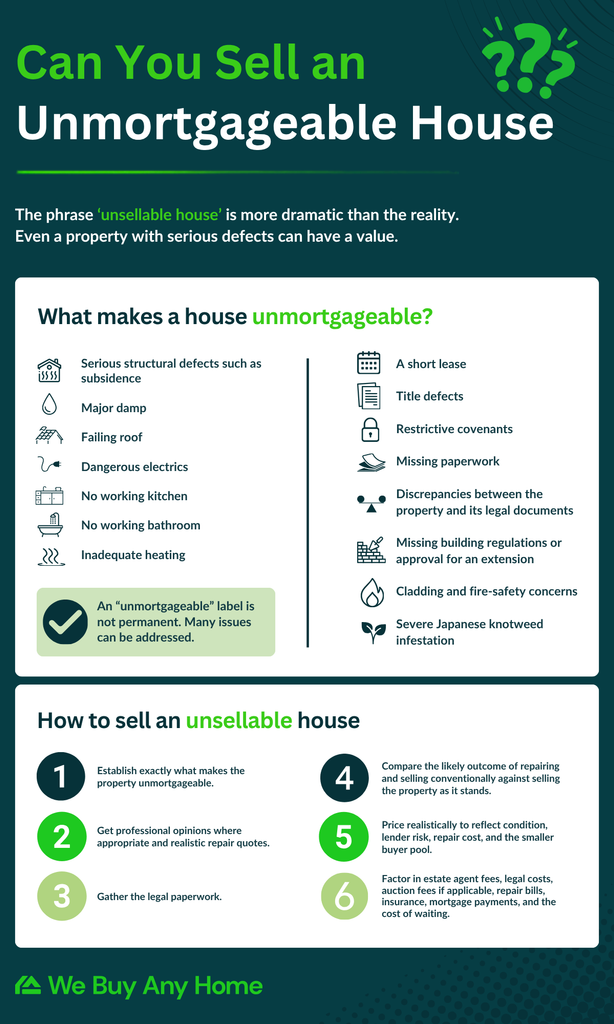
Serious structural defects are an obvious example, such as subsidence. Major damp, a failing roof, dangerous electrics or severe disrepair can cause similar concerns.
A property with no working kitchen or bathroom, inadequate heating or serious health and safety problems may also struggle to pass a lender’s requirements. Non-standard construction can be another issue.
You may also come up against legal problems. A short lease, title defects, restrictive covenants, missing paperwork or discrepancies between the property and its legal documents can all complicate a mortgage application. Missing building regulations or approval for an extension could also cause headaches.
Cladding and fire-safety concerns have become another consideration for some properties, while environmental issues such as severe Japanese knotweed infestation can affect lender and surveyor assessments.
Don’t forget that an ‘unmortgageable’ house isn’t a permanent label: in many cases, you can do something about it.
Why won’t a mortgage lender lend?
It comes down to risk, and each individual might assess this differently. The final position depends on the buyer’s lender, survey, valuer, solicitor and the specific issue.
Mortgageability isn’t a fixed yes/no. You can remedy some of the problems, and any judgement you receive is typically based on a particular set of circumstances.
What does unmortgageable mean for the buyer pool?
When you remove mortgage buyers from the equation, you remove a large chunk of the potential market.
Instead, you’re looking for people with enough cash (including those who might have taken out a loan) to buy your property outright, or specialist investors and developers who are comfortable with risk.
That can mean fewer viewings, fewer offers and longer negotiations. Buyers who remain interested may also carry out much more detailed due diligence. You’re likely to get lower offers, too.
Should you repair an unmortgageable house before selling?
When you’re about to sell an unmortgageable house, this is probably the biggest decision you face.
If the problem is relatively straightforward and you have the money available, fixing your property may open up the conventional mortgage market again. Fix the roof, resolve the electrical issue, obtain the necessary paperwork or address the structural problem, and you may have a much larger pool of buyers.
Repairs come with their own risk, though. A survey may reveal a problem that is more extensive than expected. Quotes can rise and work can overrun, forcing you to pay for temporary accommodation or storage in the meantime.
The government’s guidance recommends gathering important paperwork before marketing and being upfront about known defects.
If a problem isn’t fixed, it should be reflected in your pricing and disclosed. There’s also a middle ground: you might obtain professional reports and repair quotes without actually carrying out the work. That gives potential buyers better information.
What paperwork should you have ready?
Preparation is more important than ever when selling an unmortgageable property. You should gather all of the following paperwork to give yourself the best chance:
- Title documents
- Energy Performance Certificate
- Planning permissions
- Building regulations completion certificates
- Guarantees
- Electrical and gas certificates
- Window certificates
- Relevant warranties
- Lease details
You shouldn’t hide known problems. It’s better to deal with the issue honestly from the outset. A buyer discovering it during a survey can lead to renegotiation, or a collapsed sale.
Could an auction be the answer?
An auction is an alternative option that can make sense when traditional mortgage buyers are struggling to buy your house.
The attraction is obvious: you can put your property in front of investors and cash buyers who are accustomed to buying houses requiring work. Competitive bidding can also push the price higher than you might initially expect.
Don’t forget, though, that there are downsides to auctions as well. You get charged fees, and you may need to pay for legal preparation before your property goes to auction.
A reserve price can protect you from accepting an offer below your minimum, but setting it too high can mean your property doesn’t sell.
It’s also worth knowing what happens when the hammer falls. At a traditional auction, contracts are exchanged at that moment, so the winning bidder is legally committed to buying your home and usually pays a deposit (often 10%) on the day. You won’t have the money in your account straight away, though: completion typically follows within around 28 days, depending on the auction’s terms
What about a cash buyer for an unmortgageable house?
If you don’t want to spend months dealing with an estate agent, arranging repairs, or simply need a more certain sale, a cash house buyer for an unmortgageable house is worth considering.
For an unmortgageable property, a cash buyer can be one of the most viable routes to a sale. Because quick house sale services don’t rely on mortgage finance, a lender’s view of your property’s condition or construction doesn’t stop the sale. These buyers can often complete much faster than a conventional transaction, without you having to pay for repairs first.
Some companies may offer substantially below market value or have unclear fees. So, make sure you check that your company is a member of the National Association of Property Buyers or registered with The Property Ombudsman. Otherwise, it could be better to walk away.
When you’re in the right position, though, selling to a cash buyer means you’re no longer waiting for a lender to decide whether your property is acceptable.
We Buy Any Home provides more information about its cash-only house service, including how a cash sale differs from a conventional mortgage-dependent purchase.
How to sell an unsellable house
The phrase ‘unsellable house’ is more dramatic than the reality. Even a property with serious defects can have a value.
Before deciding what to do, establish exactly what makes your property unmortgageable. Get professional opinions where appropriate, along with realistic repair quotes. Then gather your legal paperwork.
Compare the likely outcome of repairing and selling conventionally against selling your property as it stands. You need to be realistic with your pricing, too: an unmortgageable property must be priced to reflect condition, lender risk, recent market conditions, repair cost and the smaller buyer pool.
Don’t look at the asking price in isolation, either. Factor in possible estate agent fees, legal costs, auction fees if applicable, repair bills, insurance, mortgage payments and the cost of simply waiting. When calculating all these selling costs, check whether figures include VAT before using them.
Don’t forget that external factors play a part. For example, RICS reports that the average time from listing to completion recently rose to 21.5 weeks, the longest duration recorded since the dataset began in 2017.
Frequently Asked Questions
What makes a house unmortgageable?
Common problems include serious structural defects, significant damp, major roof problems, unsafe electrics, and severe disrepair.
Other examples are inadequate facilities, short leases, non-standard construction, title issues, or missing building regulations paperwork.
You could also have problems with some cladding or fire-safety concerns and serious Japanese knotweed. The exact decision depends on the property and lender.
Can you sell an unmortgageable house?
Yes. You can sell an unmortgageable house, but your buyer pool is likely to be smaller. Cash buyers, investors, developers and auction buyers may be more realistic prospects.
Do cash buyers buy unmortgageable houses?
Yes, some do. A cash buyer may be more willing to consider a property that a mainstream mortgage lender will not currently accept. They’ll still carry out legal and financial checks.
Should I repair before selling?
Not always. Compare the likely additional sale proceeds with the full cost and hassle of carrying out the work.
Will I have to sell below market value?
Not automatically. However, a smaller buyer pool, repair costs and increased risk can affect offers. An investor or cash buyer may offer less than an owner-occupier would pay for a fully mortgageable property because they take on more risk.
Can an auction help?
It can. Auctions can attract cash buyers and investors who are comfortable with properties requiring work. However, auction fees, reserve-price decisions and the completion process all need to be considered before choosing this route.
Selling an unmortgageable house
If getting the maximum possible price matters most and you can afford to wait and carry out the necessary work, repairing and selling traditionally may be worth considering.
If speed, certainty and avoiding a long repair project matter more, a cash sale may be the more practical option.
If you want to explore a faster sale for your flat or house without committing to repairs first, you can get a cash offer from WeBuyAnyHome and see what your options look like. Click here to see how it works.