Selling a house can already feel like a paperwork marathon. So, if your solicitor mentions something you haven’t heard of before, it might feel a bit frustrating.
A ‘limited title guarantee’ is a common example. Don’t worry, though, because the meaning of a limited title guarantee is simple: a set of promises that can be implied by law when property is transferred.
A limited title guarantee doesn’t automatically mean there’s an issue with your house, and it doesn’t mean you can’t sell it.
Keep reading for everything you need to know about selling with a limited title guarantee.
What is a title guarantee?
A title guarantee is a set of promises that can be implied by law when property is transferred. These are known as ‘covenants for title’. There are two main types: limited title guarantee and full title guarantee.
You may also come across implied covenants, which are promises that the law treats as part of a house transaction even though they haven’t necessarily been written into the deed.
Limited title guarantees are governed principally by the Law of Property (Miscellaneous Provisions) Act 1994.
Both a limited title and full title provide some basic assurances. For example, the seller generally promises that they have the right to sell and will give further assurance where reasonably required.
The difference is the extent of the seller’s assurances about things that may have happened to the property during their ownership or that they know about.
Full title guarantee vs limited title guarantee
Are you wondering what a limited title guarantee and full title guarantee are? You’re in the right place.
With a full title guarantee, the seller gives broader assurances, including that the property is free from charges, encumbrances and certain third-party rights. It also assures the buyer that the house isn’t subject to the legal qualifications around matters they don’t/couldn’t know about.
With limited title guarantee house sales, those assurances are narrower. Broadly speaking, the seller promises that they haven’t created or allowed certain charges, encumbrances or third-party rights to arise, and that they aren’t aware of someone else doing so.
So, it’s less about the physical condition of your house and more about what the seller can properly promise about the property’s legal history. This is a conveyancing/title issue, and, when selling, you should always ask your solicitor to explain how the wording applies to your specific sale.
Why would a seller have a limited title guarantee?
Limited title guarantee house sales can appear in a few common situations.
Probate sales are one example, as the person selling the property isn’t the one who owned it/lived there. Subsequently, they can’t make total guarantees about what has happened – there might be things they don’t know.
Sales by trustees or personal representatives are another example, as is mortgagee/receiver sales. The same issue can arise when a company sells a property. In all these cases, their knowledge of the property’s history may be limited.
Why are buyers concerned?
Sometimes, buyers could feel alarmed about the concept of a limited title guarantee. This might be justified – or other times, less so – but it’s still something for you to be aware of when selling.
Uncertainty around undisclosed changes is always likely to cause concern, especially when there’s the potential for future enforcement. When making such a large purchase, many people want all the information about property and land before committing, otherwise, they might walk away.
In many transactions, though, the limited guarantee reflects the seller’s circumstances rather than a defect in the property. The buyer’s solicitor is more than welcome to investigate any areas of uncertainty.
There are also occasions when an estate agent might misrepresent the situation. In many cases, there’s nothing wrong at all.
Can selling with a limited title guarantee cause delays?
Yes, it can stop you selling your house fast in some circumstances. A buyer’s solicitor will usually make extra enquiries, which takes more time. They’ll also want to see more documentation than might typically be the case.
Discussion could arise around indemnity. Meanwhile, if requests for title documents come in, the seller’s solicitor will need to spend time tracking these down.
A house with limited title guarantee could also be subject to a lender review. This sometimes triggers renegotiation if the lender reduces how much they’re willing to give the buyer.
Why do mortgage lenders care?
The UK Finance Mortgage Lenders’ Handbook outlines requirements for solicitors acting for lenders. Matters affecting title, charges, planning, searches, lease terms and other defects sometimes need to be reported to the lender.
The solicitor acting for the buyer and lender carries out the necessary checks and, once satisfied, can provide the lender with an Approved Certificate of Title. This certificate confirms that the solicitor considers the property and transaction to meet the lender’s requirements and that the mortgage can be properly registered. They’ll only do this once they feel that they’ve received adequate information.
What can you do if a buyer has concerns?
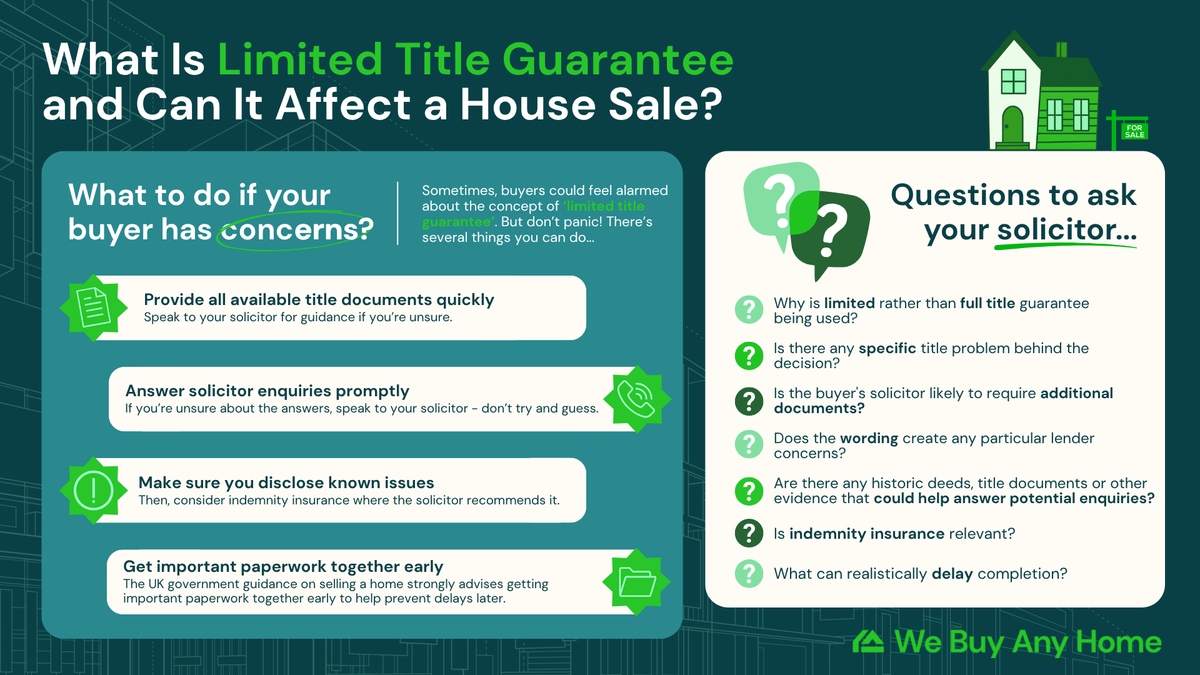
When selling a house with limited title guarantee, don’t panic. There are several things you can do to improve the situation.
Provide all available title documents and answer solicitor enquiries quickly. Speak to your solicitor if you’re unsure about an answer – don’t try to guess it yourself.
Make sure you disclose known issues. Then, consider indemnity insurance where the solicitor recommends it, or agree to a route that gives the buyer/lender enough comfort.
The UK government guidance on selling a home strongly advises that getting important paperwork together early can help prevent delays later.
If you want to understand the paperwork you may need, We Buy Any Home’s guide to documents needed to sell a house provides a useful overview.
You can also read more about proof of sale and the documents involved in demonstrating your ownership.
Questions to ask your solicitor:
- Why is a limited rather than full title guarantee being used?
- Is there any specific title problem behind the decision?
- Is the buyer’s solicitor likely to require additional documents?
- Does the wording create any particular lender concerns?
- Are there any historic deeds, title documents or other evidence that could help answer potential enquiries?
- Is indemnity insurance relevant?
- What can realistically delay completion?
Frequently Asked Questions
What does a limited title guarantee mean?
It means the seller is giving a narrower set of implied promises about the property’s title than they would normally give under a full title guarantee. The exact legal effect depends on the transfer and the circumstances.
Is a limited title guarantee bad?
No. It isn’t automatically a defect or warning sign. It’s often used because the seller doesn’t have sufficient knowledge of the property’s entire history to give the broader assurances associated with a full title guarantee.
Can you sell with a limited title guarantee?
Yes. A property can be sold with a limited title guarantee. The buyer’s solicitor and, where applicable, mortgage lender may simply carry out additional checks before the transaction can proceed.
Why would a seller use a limited title guarantee?
It’s commonly appropriate where the seller has limited knowledge of the property’s history, such as in probate, trustee, receiver, mortgagee, company or attorney sales.
Will a lender accept a limited title guarantee?
It depends on the lender and the circumstances. Mortgage lenders have their own requirements, so the buyer’s conveyancer should establish whether the particular lender is satisfied with the title and transfer arrangements.
What’s the difference between a full and limited title guarantee?
Full title guarantee vs limited title guarantee is a common question. Full title guarantee provides broader assurances about the property’s title, including certain assurances concerning charges, encumbrances and third-party rights. A limited title guarantee provides narrower assurances, particularly reflecting what the seller has personally done or knows about.
A limited title guarantee shouldn’t stop you selling your house
In many cases, a limited title guarantee simply reflects the fact that the person selling the house can’t reasonably guarantee everything about its history. Probate and trustee sales are good examples.
The important thing is to understand what the wording means in your particular transaction. Get your title documents together, answer enquiries promptly and ask your conveyancer whether anything about the guarantee is likely to concern the buyer or their lender.
Make sure to follow your solicitor’s legal guidance. If you’ve got an experienced one, then they’ve probably dealt with this before.
If the sale is becoming bogged down in title questions and your priority is a simpler, more certain route, a cash house buyer may be worth considering. Just remember that speed and certainty can come with a price trade-off compared with achieving the maximum possible price on the open market.
If that trade-off makes sense for your circumstances, you can get my cash offer from We Buy Any Home to find out how it works and explore your options.