When you’re preparing to sell your house, it’s difficult to keep track of all the different documents you need.
Some of them seem obvious and difficult to forget. Others are less commonly talked about – but that doesn’t make them unimportant. A prime example is an Electrical Certificate.
Buyers, solicitors, surveyors and even mortgage lenders may ask questions about your property’s electrics. Especially if the house is older, has recently been extended, or shows signs of dated wiring.
That’s where an Electrical Installation Condition Report comes in.
If you’re selling an owner-occupied property, you don’t usually need an electrical certificate to sell your house.
That said, a buyer is perfectly entitled to ask questions about the condition of your electrical installations. Their solicitor may raise enquiries, or their surveyor may recommend further investigation. You sometimes encounter mortgage lenders that want extra reassurance.
Even though you aren’t legally required, having the right paperwork can often make the transaction much smoother.
Owner-occupied homes and rented properties are different
When searching,’Do you need an Electrical Certificate to sell a house?’ much of the confusion comes from the rules that apply to landlords.
For privately rented properties, landlords have legal duties to ensure electrical installations are inspected and tested by a qualified person at least every five years. Tenants get a copy of the resulting Electrical Installation Condition Report (EICR). This was expanded to the social rent sector in 2025.
Other tenanted properties have different rules, such as care homes or student halls of residence. Ask a legal expert for guidance.
Legal requirements don’t automatically apply when an owner-occupier decides to sell. So, if someone else lives in your house, you need electrical safety documentation. If you live there, you don’t.
What is an EICR?
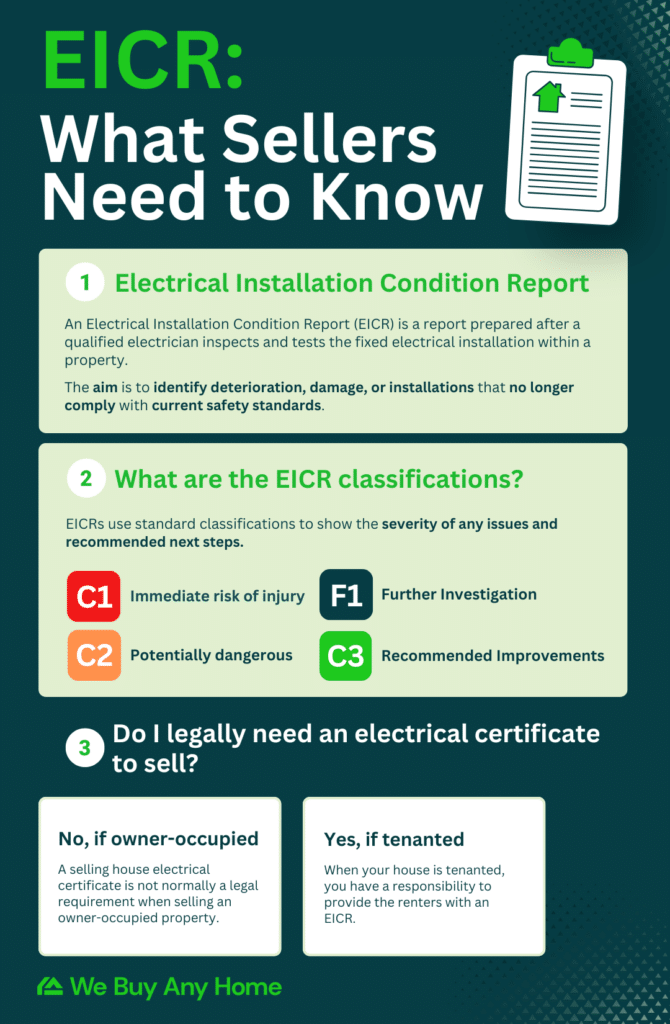
An Electrical Installation Condition Report (EICR) is a report prepared after a qualified electrician inspects and tests the fixed electrical installation within a property.
It doesn’t guarantee that nothing electrical will ever go wrong. Instead, it gives a professional assessment of the condition of the installation on the day it was inspected.
During the inspection, the electrician checks items such as the wiring, sockets, switches, and lighting circuits. They’ll also look at the fuse box, earthing, bonding and permanently connected equipment.
The aim is to identify deterioration, damage, or installations that no longer comply with current safety standards.
Many electricians recommend periodic inspections for owner-occupied homes roughly every ten years. Meanwhile, rented properties require inspections every five years.
Understanding EICR classifications
Don’t let the classification system confuse you. It’s actually quite simple.
A C1 classification means danger is present and there’s an immediate risk of injury.
A C2 classification means the installation is potentially dangerous and remedial work is needed.
FI stands for Further Investigation, meaning additional investigation is needed without delay.
A C3 classification is less serious and simply recommends improvements rather than identifying something considered unsafe.
Other electrical paperwork you may already have
An EICR when selling a house is not the only document connected with a property’s electrics.
If electrical work has been carried out previously, you may also have an Electrical Installation Certificate. This is commonly issued after major installation work or a full rewire.
Smaller alterations may be accompanied by a Minor Electrical Installation Works Certificate.
Where notifiable electrical work has been done under Part P of the Building Regulations, you may also have a Building Regulations Compliance Certificate. This confirms that the work was properly certified.
These documents are often far more useful than you realise. Especially when buyers ask questions during conveyancing.
When might buyers ask for an EICR?
Someone buying your house is unlikely to ask for an EICR if the property appears modern and well-maintained. Some people do, though, as it gives them peace of mind.
Older properties often attract additional scrutiny, particularly if they still have an older-style fuse box or visibly dated wiring. A surveyor may recommend an electrical inspection after noticing signs of ageing installations, visible defects or alterations.
Extensions, loft conversions, rewires and recent electrical work may also prompt questions if supporting certificates can’t be produced.
None of this necessarily means anything is wrong. Buyers simply want reassurance before committing to one of the biggest purchases of their lives. If you don’t make them feel confident, they may choose to walk away.
Does old wiring automatically mean trouble?
This is probably one of the biggest myths surrounding selling your house.
Many homeowners worry that older wiring automatically makes their property unsafe or unsellable, but in many cases this isn’t true.
Electrical installations naturally deteriorate over time. Periodic inspections are recommended for that reason. Age alone doesn’t determine safety, though. Condition, alterations, previous workmanship and the outcome of a professional inspection are far more important. Don’t assume that old wiring is automatically unsafe.
Equally, newer installations aren’t immune from faults if they have been poorly installed or altered.
Can missing paperwork delay a house sale?
Missing certificates don’t automatically stop a sale, but they can create extra enquiries.
Your solicitor may need to explain why paperwork can’t be produced. The buyer’s solicitor is likely to ask additional questions about this.
In many cases, your buyer will commission an EICR before exchange. The cost could need to be covered by you. If issues are identified, they may request remedial work, negotiate a price reduction or simply ask for quotes before proceeding.
In slower markets, buyers often have more confidence to negotiate over uncertainty. In stronger markets, they may be more willing to proceed regardless.
What if you don’t have any electrical paperwork?
You shouldn’t panic if you don’t have any electrical paperwork. It’s not the end of the world.
Start by checking your records. If previous electrical work was carried out, contact the contractor who did it. They may have it on file. Or they could’ve sent it to you at the time.
Where Building Regulations approval was required, you may also be able to locate records through your local authority or the relevant competent person scheme.
If you’re unsure whether paperwork exists, speak with your solicitor before assuming the worst.
In some cases, commissioning a new EICR may simply be the quickest way of answering your buyers’ questions and selling your house fast.
Don’t attempt DIY electrical fixes
It can be tempting to tidy up obvious electrical issues before viewings begin. This is rarely a smart idea, though.
Replacing a broken light switch cover is one thing, but carrying out electrical repairs to satisfy a buyer is something completely different.
Electrical work should always be done by someone competent to carry it out safely. Improvised DIY repairs can create greater problems than the original fault and may raise even more questions during the sale.
Other documents buyers may ask for
Electrical paperwork is just one of the documents involved in selling your property. You’ll want to get everything listed below prepared, too:
- Planning permissions
- Building Regulations certificates
- Guarantees
- FENSA certificates
- EPCs
- Title Deeds
- TA6 form
- TA10 form
- Insurance policies
- Gas safety certificate
If you’re preparing to sell, it’s worth reading WeBuyAnyHome’s guide to the documents needed to sell a house so you can gather everything in advance and reduce the chance of unnecessary delays.
Frequently Asked Questions
Do I legally need an Electrical Certificate to sell?
Usually not. Most owner-occupied homes can be sold without an Electrical Certificate. You will need it if it’s tenanted.
What is an EICR?
An Electrical Installation Condition Report is an inspection report assessing the condition of a property’s fixed electrical installation. It identifies defects, deterioration and safety concerns but doesn’t guarantee future performance.
Can a buyer ask for an EICR?
Yes. Buyers are free to request an EICR, particularly if your property is older or their survey recommends further investigation.
How long does an EICR last?
There’s no expiry date in law for owner-occupied homes. Periodic inspections are commonly recommended every ten years for owner-occupied properties and every five years for rented homes.
Can electrical problems stop a house sale?
They can delay a transaction if buyers request further inspections, remedial work or they decide to renegotiate the purchase price. In many cases, though, issues can be resolved through discussion and appropriate certification.
Do landlords need electrical certificates?
Yes. Landlords have legal responsibilities to arrange periodic inspections and provide tenants with an EICR in the UK.
Do you need an electrical certificate to sell a house?
For most homeowners, the answer is no. A selling house electrical certificate is not normally a legal requirement when selling an owner-occupied property. It might make your buyer feel more confident to have it anyway, though.
When your house is tenanted, you have a responsibility to provide the renters with an EICR. In this context, you must get one.
If missing paperwork, electrical concerns or buyer negotiations are slowing your sale, WeBuyAnyHome is a cash house buyer that offers a faster, chain-free alternative. You can start today by visiting Get My Cash Offer.