Selling your house isn’t just about listing it on Rightmove. While the marketing can seem like the most exciting part, you also need to get the basics right if you want the process to move at a reasonable pace.
‘What paperwork do I need to sell my house UK?’ is one of the most common search terms for homeowners. When you get this area spot-on, you could avoid some nasty surprises further down the line.
Some documents are essential before you even market the property, while others become important once you accept an offer. A few documents only apply in special circumstances, such as leasehold flats, probate sales or homes with extensions.
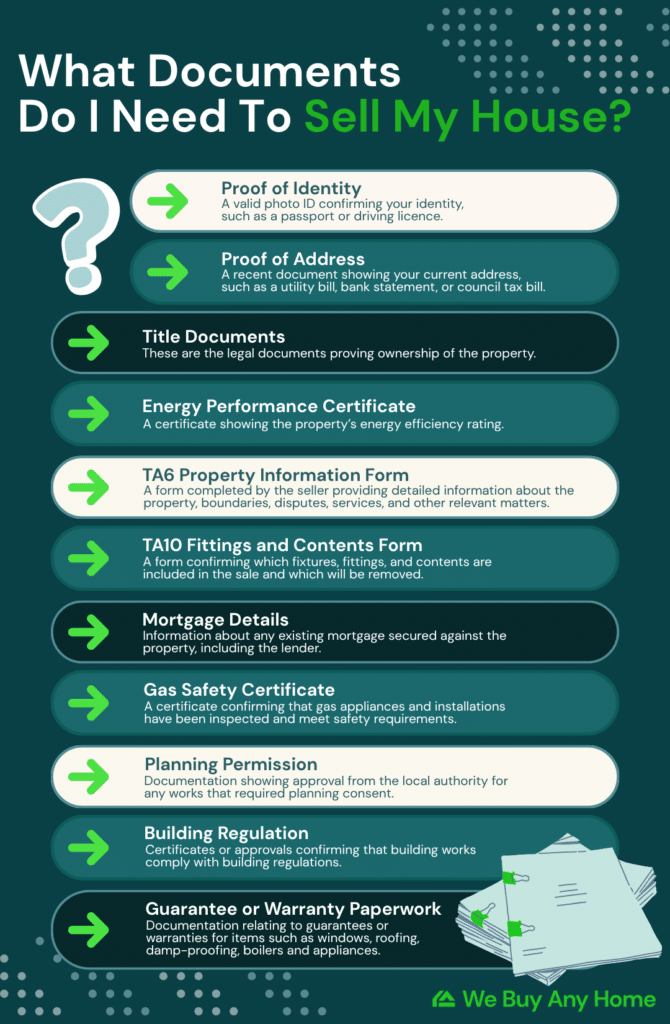
Quick checklist of documents needed to sell your house:
Don’t want to read through the rest of this article? That’s fine. Here’s a quick checklist of what you need:
- Proof of identity
- Proof of address
- Title documents
- Energy Performance Certificate
- TA6 Property Information Form
- TA10 Fittings and Contents Form
- Mortgage details
- Gas safety certificate
- Any other planning, building regulation, guarantee or warranty paperwork
If the home is leasehold, you will also need leasehold documents, service charge information, ground rent details, buildings insurance information and usually a management information pack.
Proof of identity and proof of address
It might sound obvious, but before anyone can get too excited about offers, you first need to confirm who you are. This is important for anti-money laundering checks.
You will usually need photo ID, such as a passport or driving licence. You should also get proof of address, such as a recent utility bill, council tax bill, bank statement or mortgage statement. If there are joint owners, both will need to prove their identity.
Title deeds and Land Registry documents
Your buyer needs proof that you own the property and have the right to sell it. For most homes in England and Wales, ownership is recorded electronically at HM Land Registry.
You or your solicitor can search the register and obtain copies. GOV.UK currently says it costs £7 to get a title register or title plan online, while official copies sent by post cost £11 per document.
Older unregistered properties can be trickier. Your solicitor may need to investigate and help prove title.
Energy Performance Certificate
An Energy Performance Certificate, or EPC, shows how energy efficient your property is, rating it from A to G. If you’re wondering ‘can I sell my house without an EPC?’, the answer is no, you can’t.
You need an Energy Performance Certificate to sell your house – but you may already have a valid one without realising it. Make sure to check so you don’t spend money on it unnecessarily.
There are exceptions, such as some listed buildings, places of worship, temporary buildings and certain very small standalone buildings. If you’re an average seller, though, then you should assume you need one.
TA6 Property Information Form
The TA6 Property Information Form gives your buyer crucial information about the house.
The Law Society says the TA6 6th edition is designed for use once an offer has been accepted, although sellers can complete it in advance.
The form covers issues such as boundaries, disputes, notices and alterations. There are also sections for planning, building control, guarantees and flooding.
Environmental matters and rights of way cover two more sections. Then, at the bottom, you fill in details about parking, services, occupiers and completion arrangements.
This is not the place to be creative. You need to be transparent and accurate. Otherwise, it can come back to bite you.
TA10 Fittings and Contents Form
The TA10 Fittings and Contents Form explains what is included in the sale and what is not. It may sound minor, but it prevents the classic argument over curtains, light fittings, carpets, appliances and garden items.
The form is laid out incredibly simply: you tick ‘included’ or ‘not included’ next to each item that’s listed. This makes it incredibly clear, so there’s no ambiguity about what you need to leave behind and what you take with you.
It also provides protection in the case of a buyer claiming parts of the property that you would not like to be included in the sale.
Leasehold documents
Leasehold sales are usually more paperwork-heavy than freehold sales.
In this situation, the documents needed to sell a house include the lease, ground rent details and service charge accounts. You’ll also need to hand over the buildings insurance information and details about the freeholder or managing agent.
You may also need a management information pack. Try to get this from the landlord or managing agent. It should also include replies to the LPE1 form and information about service charges, insurance, planned works and arrears.
Planning permission and building regulations
Planning permission is one of the most important areas. It should give clear details on any extensions, conversions, or major alterations you’ve made to your property. Otherwise, it’s an accident waiting to happen for your buyer, who could get ordered to undo it at their own expense.
If an extension lacks the right approval, your buyer may ask for indemnity insurance. They could also want a significant price reduction or additional checks. In some cases, your buyer could walk away altogether.
If work was done under a competent person scheme, such as certain window, electrical or heating work, there may be certificates available.
Warranties, guarantees and certificates
Sellers often ask, ‘What certificates do I need to sell my house?’
There is no single magic certificate pack, but useful paperwork can include new-build warranties and damp-proofing guarantees. There’s also roof guarantees, double-glazing certificates, and boiler installation paperwork.
You’ll also ideally have electrical installation certificates and warranties for appliances included in the sale. These aren’t always legally required to market your property, but they can reassure your buyers.
Gas safety certificates
Gas safety certificates cause confusion because the rules are different for owner-occupiers and landlords.
If you live in the property yourself, you don’t generally need a landlord gas safety certificate simply to sell. But if the property is rented, landlord duties apply.
The Health and Safety Executive says landlords must arrange annual gas safety checks for gas appliances and flues they provide, keep records and give copies to tenants.
Even where a certificate is not legally required for the sale itself, buyers may ask about boiler servicing, gas appliance records or installation paperwork.
Mortgage and redemption details
If you have a mortgage, your solicitor will need lender details so the mortgage can be paid off when the sale completes. This is known as redeeming the mortgage.
You should know who your lender is, roughly what you owe and whether there are early repayment charges. If you are selling to buy another home, you should also speak to your lender about porting the mortgage or arranging a new one.
This might not sound like the most exciting paperwork, but it affects your final proceeds.
Documents needed in special circumstances
Some sales need extra paperwork. If you are selling after someone has died, probate documents or letters of administration may be needed.
GOV.UK notes that if a property is sold to a third party after a sole owner has died, the buyer may need an official copy of the grant of probate or letters of administration.
If you are selling because of divorce or separation, there may be court orders, consent orders or ownership issues to deal with.
If the property is Shared Ownership, you will need documents from the housing association and details of staircasing, restrictions and nomination rights.
If the property has a granny annexe, or holiday let use, then expect additional questions. The more unusual the property, the more paperwork buyers will likely want.
What if documents are missing?
Missing paperwork is not always fatal.. Remember to be upfront with your solicitor, as they may be able to get replacement copies.
Buyers are usually more forgiving of a missing document than of a seller who seems evasive.
What documents do I receive after selling my house?
Once you’ve completed the sale of your house, there are still a couple of documents coming your way as proof of sale. Make sure you get all these, and then the journey is complete.
This subject might not seem like the most exciting, but it truly matters, and your house sale can fall apart if you don’t take it seriously.