Selling a house is stressful at the best of times. So, when you discover that an alteration doesn’t have the building regulations paperwork to prove it was properly signed off, it makes things even worse.
Fortunately, this doesn’t need to be the end of the world. In some cases, you can sell a house without building regulations approval.
That doesn’t mean you can ignore the issue, though. Missing approval can raise questions from buyers, conveyancers and mortgage lenders, and it can make your sale more expensive and time-consuming.
Let’s look at the main rules around building regulations approval, and how to sell a house without all the documentation.
What is building regulations approval?
Building regulations are the safety and technical standards that building work is required to meet. They cover areas such as structural stability, fire safety, ventilation, drainage, insulation and energy efficiency.
They apply to much more than simply putting up a new extension. Depending on the work, building regulations can be relevant to alterations and installations too. This can include extensions and loft conversions, garage conversions, structural alterations such as removing a load-bearing wall, replacement windows and doors, drainage, insulation and certain electrical or heating work.
This is where homeowners sometimes get confused because building regulations approval isn’t the same thing as planning permission.
Planning permission is broadly concerned with whether development is acceptable in terms of appearance, use and its impact on the surrounding area. Building regulations are concerned with whether the actual construction or alteration meets the required technical standards.
Sometimes, you could need both – in other cases, you could need neither. There are also occasions when a registered competent person can self-certify certain work, meaning you don’t need to make a separate building control application.
Why does missing approval matter when selling?
When a buyer looks at your house, they may love the functionality and appearance and make an offer straight away. Their solicitor will be more thorough, however, and will be required to ask for building regulations completion certificates.
Your buyer’s surveyor may also recommend further investigation. Then, when your buyer needs a mortgage, the lender may have its own requirements about the property and the work carried out.
That can lead to delays, renegotiation or, in the worst cases, a sale falling through.
Government guidance specifically recommends gathering property paperwork early, including planning permission and building regulations completion certificates for alterations and additions. This can help avoid delays during the sale.
Missing paperwork isn’t the same as non-compliant work
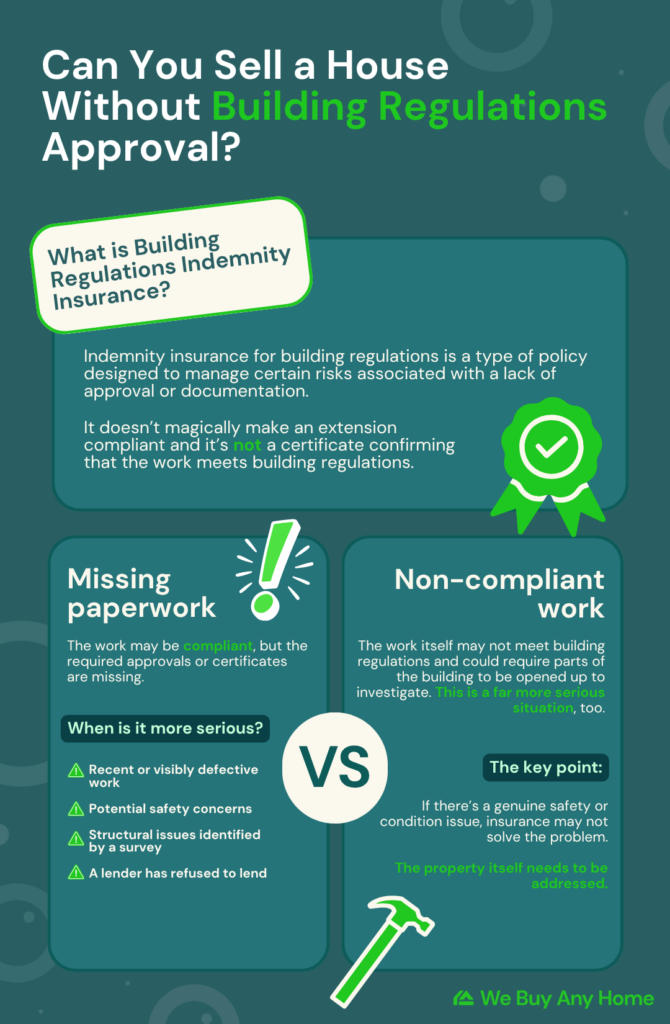
In some cases, an alteration was properly built and complied with all the building regulations. In this case, you’re facing a paperwork issue, which can usually be sorted out.
On the other hand, if your extension was built without applying for approval, and nobody ever established whether it complies, that’s a far bigger problem.
In the first instance, perhaps the previous owner has the documents, or the builder kept records. Maybe the local authority has a record of the work or the work was done through a competent person scheme (and a certificate exists elsewhere).
If the alteration is non-compliant, though, then it could collapse the sale altogether. The lender might refuse to give a mortgage, or the buyer could significantly drop their offer.
What can you do if the paperwork really is missing?
The simplest option is to look for the paperwork.
Ask the previous owner if they have copies and contact the contractor, if they’re still trading. Search through old conveyancing documents, guarantees and property files. You could also check whether the local authority has records of the work.
If the work genuinely went ahead without building regulations approval, one possible route in England is regularisation.
A regularisation certificate is a form of retrospective approval for unauthorised building work. This applies to unauthorised work started on or after 11 November 1985. The building control service can inspect the work and decide whether it complies, or whether changes are needed before a certificate can be issued.
This could trigger huge costs for the homeowner in a worst-case scenario. So, you should discuss the situation with a solicitor and, where appropriate, a qualified building professional.
What about building regulations indemnity insurance?
Another option that may come up during conveyancing is building regulations indemnity insurance.
Indemnity insurance for building regulations is a type of policy designed to manage certain risks associated with a lack of approval or documentation. It doesn’t magically make an extension compliant and it’s not a certificate confirming that the work meets building regulations.
Instead, it can give financial protection against certain losses arising from enforcement or other specified risks connected with the lack of approval.
It’s important to note that a lack of building regulations indemnity policy isn’t automatically the right answer for every property.
In particular, sellers should take legal advice before reaching out to a local authority about historic work when considering an indemnity policy. For example, contacting the council can affect whether an insurer is prepared to offer cover, depending on the circumstances.
When is the problem more serious?
Missing paperwork is more serious in some situations than others.
If the work is relatively recent, visibly defective or potentially unsafe, the situation deserves much more careful attention. The same applies where a survey has identified structural concerns or where a lender has already refused to lend.
When you’re establishing whether the work complies, it could require substantial parts of the building to be opened up. This is a far more serious situation, too.
In those circumstances, an insurance policy may be beside the point – the real issue is the condition of the property. Either way, if there’s a genuine safety problem, hiding it in the hope that nobody notices isn’t a sensible strategy.
Could you simply sell the house as it is?
In some cases, yes. Even if a bank refuses to lend on a house without the necessary building regulations certificates, a cash buyer can still move ahead, if they want. You may find that they offer a significantly reduced price, though, to reflect the extra risk.
That can mean a smaller pool of buyers, a lower offer or a longer wait for someone willing to take the property on.
For some sellers, particularly those who need a quick and certain transaction, selling to a cash buyer can be an option worth exploring. It doesn’t mean the issue disappears, though, so you should still be open about relevant problems and take appropriate legal advice.
Get organised before putting the property on the market
The best way to avoid a nasty surprise is to investigate the issue before you’ve accepted an offer. Gather whatever paperwork you have for alterations, including:
- Planning permissions
- Building regulations certificates
- FENSA or other relevant certificates
- Guarantees
- Warranties
- Information about who carried out work
Then speak to your conveyancer about anything that’s missing, such as an Energy Performance Certificate, a TA10 form, or a TA6 form. A missing certificate doesn’t automatically mean your house cannot be sold, and it certainly doesn’t automatically prove that historic work is unsafe.
If resolving the issue looks expensive or unnecessarily time-consuming, it may be worth considering whether a cash sale could provide another route forward.
If your property has historic building work, missing paperwork or condition issues, We Buy Any Home may be able to consider the property and provide a free cash offer. You can also read about how we sell your house fast for more details.
There’s no guarantee that every property will be suitable, but for homeowners who want to explore an alternative to a lengthy conventional sale, it can be worth finding out what’s possible.