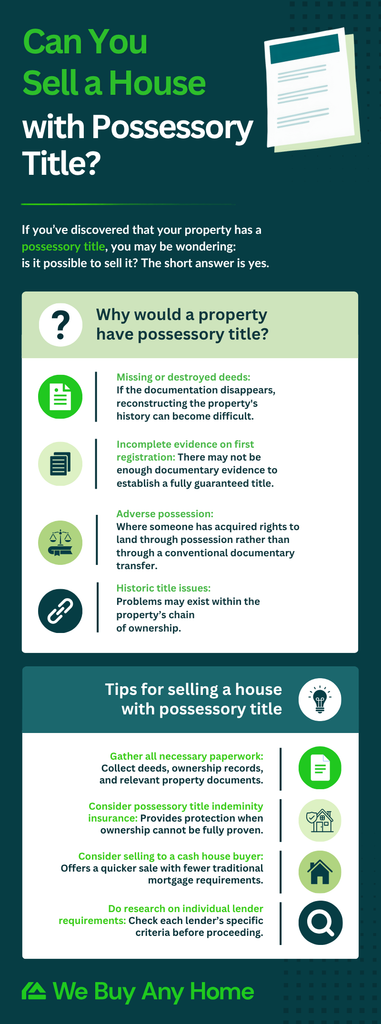
If you’ve discovered that your property has a possessory title, you may be wondering: is it possible to sell it? The short answer is yes.
You can sell a house with a possessory title, but the sale can involve more questions, paperwork and uncertainty than a property registered with an absolute title.
Your potential buyer will want to know why your house has a possessory title, and whether there are any historic claims or missing rights affecting it.
So, it doesn’t need to put a halt on your house sale, as long as you can give all parties the certainty they want.
What is the meaning of possessory title?
A possessory title means that HM Land Registry has registered the property but can’t give the same level of guarantee about the owner’s title as it can with an absolute title.
An absolute title is the strongest and most common class of registered title. A possessory title is one of the recognised alternatives.
HM Land Registry says it may be granted where someone claims to have acquired land through adverse possession, or where they cannot produce sufficient documents to prove the title. Possessory titles are quite rare.
Why would a property have a possessory title?
A possessory title on a property can occur for a range of reasons.
One of the most straightforward is missing or destroyed deeds. If the document disappears, reconstructing the property’s history can become difficult. Incomplete evidence on first registration is another example.
A possessory title can also occur through adverse possession, where someone has acquired rights to land through possession rather than through a conventional document transfer. The precise rules are complicated, so this is an area where professional legal advice is essential.
There may also be historic title issues in the property’s chain of ownership. Or a house inherited via probate could have possessory title.
Why are buyers nervous about a house with a possessory title?
Most buyers don’t want to spend their savings on a property only to discover later that someone else has a historic claim over it. This makes them vulnerable to a third-party claim.
Even if that possibility is remote, incomplete title evidence can make your buyer (and their conveyancer) more cautious, especially if there’s missing historic evidence or uncertainty around covenants/rights.
There can also be concerns about resale. Your buyer may reasonably ask themselves whether they could face the same problem when they eventually sell. This could make the sale fall through.
For a cash buyer, the question may be relatively straightforward: can the legal position be understood, assessed and managed? This makes it the best way to sell a house in some cases. For a buyer relying on a mortgage, there’s another party involved – the lender.
Can you get a mortgage with a possessory title?
Can you get a mortgage with a possessory title? The honest answer is it depends. There’s no universal rule saying that every mortgage lender will reject a property simply because it has a possessory title.
Mortgage lenders have their own requirements, and the buyer’s conveyancer must check the requirements applying to the particular lender.
A buyer might even be able to take out a loan to make the purchase.
The UK Finance Mortgage Lenders’ Handbook has general instructions as well as lender-specific requirements, although not every lender uses the Handbook. Where a lender is listed, its individual requirements can matter alongside the general guidance.
What paperwork might you need?
If you’re planning to sell a house with a possessory title, your solicitor should help you to gather all the core documents you need.
You may want the official Land Registry title register and title plan, together with any historic documents you still have. Depending on the circumstances, useful evidence could include old deeds, conveyancing correspondence, mortgage records, insurance documents, council tax or utility records and evidence of long-term occupation.
Statements of truth or statutory declarations can also be relevant where documentary evidence is missing. Solicitor correspondence may also be useful to have.
It’s also worth checking the title register early. It can reveal restrictions, covenants, rights, easements, charges and other information that may need to be dealt with during the sale.
Can possessory title indemnity insurance help?
Potentially, yes. You shouldn’t treat indemnity insurance as a magic fix, though.
Possessory title indemnity insurance may be considered as part of managing the risk associated with a title problem. It can sometimes make a buyer or lender more comfortable where the underlying risk is understood and insurable.
However, insurance doesn’t change the underlying class of title. It doesn’t magically turn a possessory title into an absolute title, nor will every policy be acceptable in every transaction.
Whether insurance is appropriate depends on the defect, the policy wording, the buyer and, where applicable, the mortgage lender. Your solicitor should advise on this.
Can you upgrade a possessory title?
In some circumstances, yes, you can upgrade a possessory title. It depends on the situation.
HM Land Registry allows an application to upgrade an inferior class of title. Where additional evidence becomes available that resolves the original problem, an application can be made to upgrade the title.
There’s also a specific route for possessory titles after they have been registered for 12 years. HM Land Registry says a possessory title can generally be considered for upgrade to absolute freehold or good leasehold title after that period, subject to the relevant requirements. The application is made using form UT1, with supporting evidence where required.
This could be worth considering before selling, particularly if your title has been possessory for many years or you’ve discovered documents that were previously missing. An upgraded title can provide greater certainty for a future buyer, their conveyancer and potentially their lender.
However, don’t assume that upgrading is always necessary or that it will be straightforward. Your solicitor can tell you whether you have a realistic case.
Does a possessory title make a house harder to sell?
In most cases, yes, as it introduces more uncertainty.
Extra enquiries can take time. A buyer may need to discuss the title with their lender, or there could be negotiations over indemnity insurance.
A buyer will sometimes become uncomfortable and withdraw. They may even attempt to renegotiate the price.
Regardless, speak to your solicitor early and gather title evidence. You should also avoid making unsupported promises to buyers.
If you want to explore the paperwork involved in selling a property, We Buy Any Home’s guide to the documents needed to sell a house is a useful starting point.
Frequently Asked Questions
What is a possessory title?
A possessory title is a class of registered title used where HM Land Registry cannot grant an absolute title because the evidence of ownership is incomplete or because the land has been acquired through possession. It’s a recognised form of registered title, not the same as having no legal ownership.
Can you sell a house with a possessory title?
Yes. You can sell a house with a possessory title. However, the buyer’s solicitor may carry out additional checks and a mortgage lender may have specific requirements. This can make the transaction more involved than a sale of a property with an absolute title.
Can you get a mortgage with a possessory title?
Possibly. There’s no single rule applying to every lender. Mortgageability depends on the individual circumstances and the requirements of the particular lender, which should be checked by the buyer’s conveyancer.
How do you upgrade a possessory title?
You may be able to upgrade a possessory title by giving HM Land Registry evidence that explains why the inferior title was granted. In certain circumstances, a possessory title can also be considered for upgrade after 12 years. A solicitor or conveyancer can advise whether an application using form UT1 is appropriate.
Does a possessory title reduce value?
Not automatically. There’s no universal percentage reduction simply because a property has a possessory title. However, if buyers perceive additional legal or mortgage risk, it could affect demand, negotiations or the number of buyers willing to proceed.
Can possessory title indemnity insurance help?
It can sometimes help manage the risk associated with a title problem, but it does not upgrade the title itself. Whether it’s suitable, and whether a particular buyer or lender will accept it, depends on the circumstances.
So, can you sell a house with a possessory title?
Yes – but you should expect the sale to attract more questions than a straightforward sale with an absolute title.
The smartest move is to find out exactly why the title is possessory, gather whatever evidence you have and ask your solicitor to assess the position before accepting an offer.
In some cases, the title can be upgraded. In others, additional evidence or indemnity insurance may help make the transaction more straightforward.
If the uncertainty of finding a conventional buyer is becoming the biggest problem, a cash buyer may offer another route. It won’t make the legal issue disappear, but it may remove some of the mortgage-related uncertainty and give you a more direct path to completion.
If you want to explore that option, you can find out how it works and sell your house fast.