You’re not alone if you feel like selling a home in Britain hasn’t changed much in the past few decades.
At a glance, it seems like it hasn’t. The typical process is the same: you speak to a couple of estate agents in your area, and then go with the one who says the things you want to hear.
It’s not surprising, though, that more sellers are starting to question the ‘traditional’ way of doing things. With the housing market becoming increasingly competitive and prices rising higher than ever before, some people appreciate the autonomy of doing it themselves.
So, is it really possible to do a better job selling your house without an estate agent than with one? The answer is both yes and no. We’ll explain more further below in this article.
Although, most people who sell a house privately don’t do so because they want more control. While that may be one of the perks, the biggest motivator is one crucial thing: money.
Estate agent fees typically sit between 1% to 3% of the final sale price. When your house costs £400,000, that equates to roughly £4,000 to £14,000 in commission.
It’s hardly a shock that homeowners occasionally look at that figure and think: surely, I can avoid that fee by doing it another way?
Let’s find out whether selling your house without an estate agent is as easy as some might have you believe…
Private sales are more common than you think…
Estate agents continue to dominate the market – but that doesn’t mean that private property sales have disappeared.
Recent research suggests that around 1 in 10 homes in the UK are now sold off-market, meaning they’re never publicly listed through the usual channels.
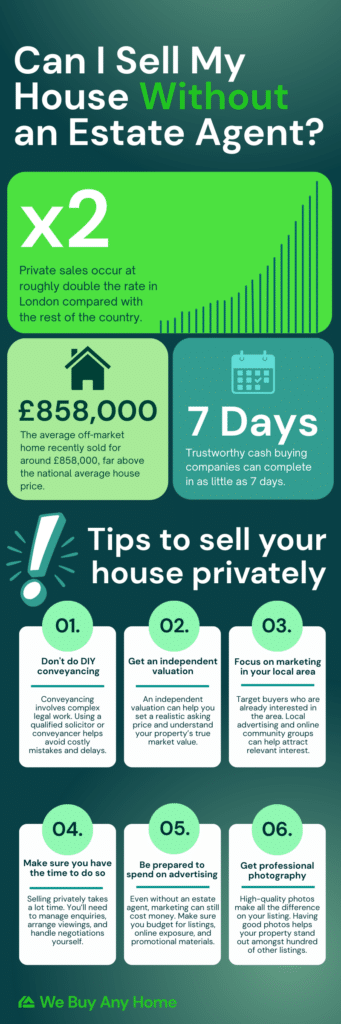
In cities like London, the proportion is even higher. Data from Hamptons indicates that private sales occur at roughly double the rate in the capital compared with the rest of the country.
Historically, this kind of quiet dealmaking happened mostly among wealthier homeowners. And there may still be a small amount of truth in this. After all, the average off-market home sells for around £858,000 (far above the national average house price).
Yet, the trend is becoming more popular amongst lower priced properties, and the average private sale price is much lower than it was a few years ago.
Across Britain, more homeowners are experimenting with alternative ways to sell. Some choose online or hybrid agents, while others go for cash buying companies.
Meanwhile, for those who want to sell privately, technology has changed the landscape. Twenty years ago, estate agents controlled access to buyers through their shop windows and mailing lists. Today, homeowners can advertise a property online themselves, share it through social media, or circulate it within local community groups.
In short, the tools once reserved for professionals are now available to all. And this means that the power dynamics in the property market are slowly starting to shift…
Let’s take a look at the success stories…
These numbers are fascinating, but they only tell part of the story. Hearing about the successful sales themselves can really bring the modern-day picture to life.
One British couple recently sold their bungalow without using an estate agent at all, and completed the deal within four months. This was faster than the average UK property sale.
Their reasoning was simple: they felt they understood the local area better than any agent. Rather than paying thousands in commission, they decided to market the property themselves.
The result? Lots and lots of hard work, followed by a successful sale and several thousand pounds saved in fees.
Stories like this are not unusual. In fact, many private sales happen almost by accident.
Sometimes, a neighbour will knock on your door with an unexpected offer. On other occasions, a letter arrives from someone who has admired your home for years. Not only is this flattering, but it can unlock a superb opportunity.
Most house sellers who opt for a private route feel comforted by the option of returning to the ‘traditional’ method, and using an estate agent, if the private sale collapses.
It doesn’t have to be a disaster, even if things go wrong. As long as you’re prepared to dedicate your time and effort, it could work out for the best.
What’s the other side of the story?
You probably think that this article has been a bit one-sided so far – so, it’s important to show the other perspective.
In most cases, sellers who use agents often achieve higher final prices. One study suggested sellers working with agents get roughly 15% more than those selling without one.
Estate agents earn their fees partly because they take care of the messy, stressful parts of the deal. And if it sounds difficult to do in theory, just wait until you’re thrown in the deep end, and have never handled any of it before. The pressure can become overwhelming. Especially since you care so deeply about the result.
One of the most common mistakes solo sellers make is overpricing. You feel emotionally attached to your home in a way others don’t – and that can blind you.
There are also security concerns, which an estate agent is well-versed in. Advertising your home means inviting strangers inside. You shouldn’t share your full address in early advertisements and avoid talking about security system details or empty periods.
Then there’s the issue of time. If you’ve got a full-time job, or children, or a busy social life, then making time for all of it can be a total nightmare.
Hosting viewings, responding to enquiries, chasing solicitors, negotiating offers, and managing paperwork will eat into all your free time. Especially when there are lots of other people in the chain that you’re trying to coordinate with.
For some homeowners, that responsibility feels empowering. For others, it becomes exhausting. You need to decide which camp you fall into.
Creative ways to sell by yourself
You may think that organising a property chain is the most difficult part of a private sale. In reality, though, marketing your house for a decent price is what will probably keep you awake at night.
Estate agents rely largely on huge property portals and established buyer networks. It’s almost impossible for you to replicate that reach as an individual seller. You’ll thus need to find creative ways to do it alone.
Easy wins include putting a ‘For Sale’ sign outside your house. On busy roads, that simple sign still works remarkably well. You could also tell your friends and family, and ask them to inform anyone who might be looking. Do the same with your neighbours.
Local advertising is another powerful tool. Community magazines, neighbourhood Facebook groups, and online forums focused on specific towns regularly show property listings.
Other methods of local promotion are worth considering, too. Research from Newcastle University shows that most homebuyers move between three and six miles from their current home. So, the odds are, your next buyer probably already lives nearby.
In this instance, leaflets, local noticeboards, and neighbourhood groups are surprisingly effective marketing channels. Just make sure you’ve got the professional photography and clear floor plans needed to back it up.
The goal is simple: if you’re competing with professional listings online, your home must look just as appealing. When your marketing looks amateur, buyers will assume that your property is, too.
Selling to a friend: the importance of treading carefully
At first glance, selling your house to a friend could seem like the ideal scenario. You avoid estate agent fees and marketing costs and ensure that your new owner is someone you get on with.
The reality, though, is often far less than perfect.
A house sale is ultimately a business deal involving hundreds of thousands of pounds. Even the strongest friendships experience strain under that kind of financial pressure. Emotions will be high – especially when you’re working on a tight deadline.
Imagine that a survey uncovers unexpected structural issues, and your buyer asks for a considerable price reduction. If your buyer is your friend, declining that request risks damaging the relationship. Accepting it risks putting yourself at a financial disadvantage.
Then there’s the awkwardness of negotiation itself. Friends often hesitate to push for a better deal, which can leave both sides quietly dissatisfied. Resentment can build up, without it ever being addressed.
Solicitors can also complicate matters. Their professional duty is to protect their client’s interests, not preserve friendships. That means negotiations occasionally become confrontational – even when both parties don’t want it to be.
None of this means selling to a friend is a bad idea. You just need to treat it as a professional transaction, where business is put first: not a ‘favour between friends’. Once money enters the equation, even the best friendships benefit from clear boundaries.
How private selling will change in the future
The British property market continues to operate in a slow, old-fashioned way. Yet, the most successful marketing methods are starting to involve new, innovative approaches.
Online technology is the biggest driver. Then, at the same time, the rise of hybrid agents and cash buying companies has introduced new selling models that sit in between private sales and traditional agencies.
Even the economics of selling are shifting. As property prices rise, estate agent commissions grow proportionally larger. A modest percentage fee can quickly turn into a five-figure amount, before you’ve even blinked.
That reality inevitably pushes some sellers to explore alternatives.
In the years ahead, the line between private sales and traditional agency sales will likely blur even further. Technology platforms may offer homeowners tools to manage listings, viewings, and negotiations themselves while still accessing major property portals.
Artificial intelligence may eventually assist with all parts of the selling process. This includes property valuations, marketing strategies, and buyer screening.
Estate agents themselves will adapt. So, it’s possible that the future property market will include both models operating side by side.
So… can you sell your house without an estate agent?
The honest answer is: it depends entirely on your circumstances.
If you already have a buyer lined up, understand the property market, and have the time to manage the process, selling privately can absolutely work. Many homeowners complete successful sales this way every year.
Just remember that there’s huge pressure and responsibility on your shoulders. Especially when so many other parties will be affected by the outcome.
Make sure you price the property realistically and market it effectively. Always stay calm while negotiating prices, and don’t forget to get a solicitor who does all the heavy lifting on the legal side.
Estate agents exist for a reason. Their experience, contacts, and negotiation skills can make an already difficult process far simpler.
So, the question isn’t really whether selling privately is possible, because it absolutely is. The real question is whether you want to take on the job yourself – and how much lower your selling price will be if you lack the skills you need.
So, be honest about your skillset, and be honest about your asking price. Otherwise, it’s pointless saving thousands on an estate agent’s commission if you can’t match the price that they would’ve sold it for.