It’s not always straightforward to sell a tenanted property.
Not every buyer is looking to buy a house that someone else is living in; this can turn lots of people away. Then, on top of that, there are new rules introduced in the Renters’ Rights Act that you must comply with.
Selling a house with a sitting tenant, or choosing to evict them first, is one of the key choices in this process.
Neither route is automatically better than the other. It depends on your circumstances, the price you want, and how quickly you need to sell.
Let’s take a look at the best way to navigate this journey.
Tenants in situ, sitting tenants and vacant possession explained
Before weighing up the options, it’s important to understand the terminology.
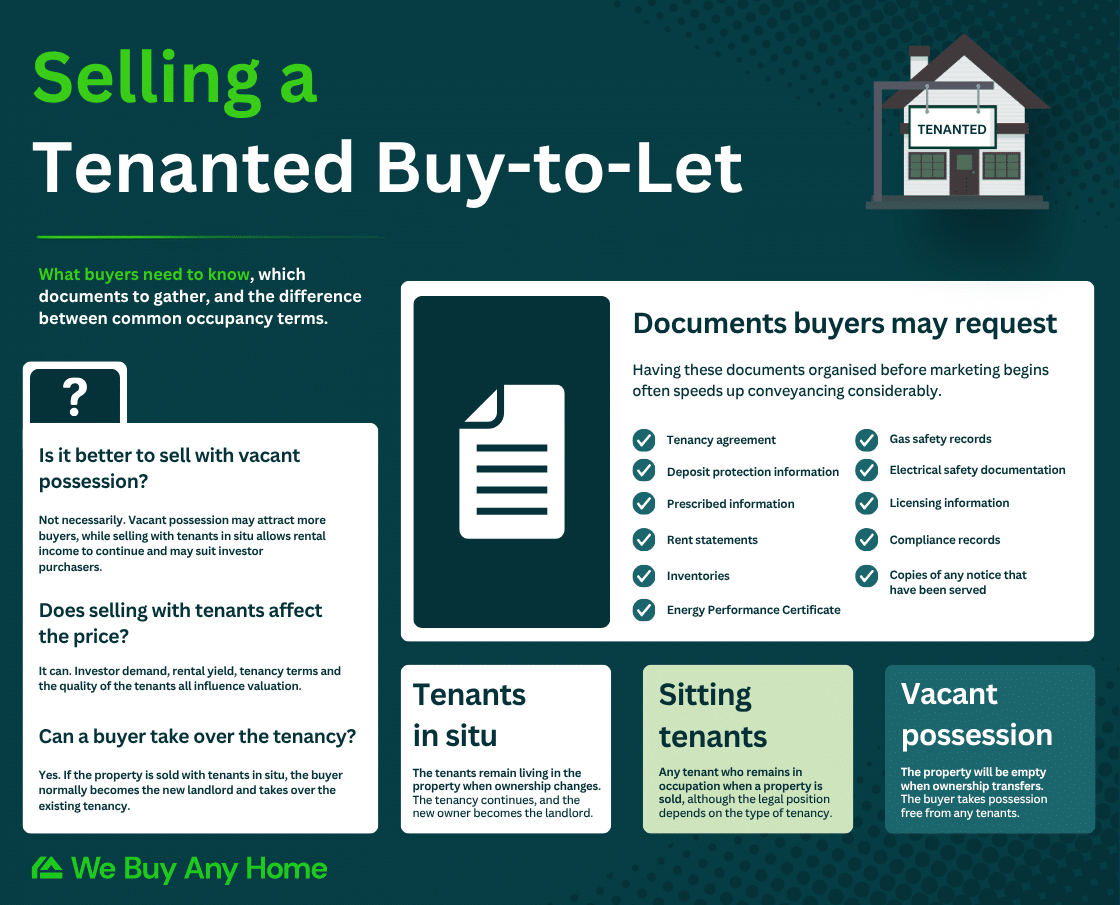
A property sold with tenants in situ means the tenants remain living in the property when ownership changes. The tenancy continues, and the new owner becomes the landlord.
Questions of “what is a sitting tenant?” can often cause confusion because it’s sometimes used interchangeably with tenants in situ. The term describes any tenant who remains in occupation when a property is sold, although the legal position depends on the type of tenancy.
Vacant possession means the property will be empty when ownership transfers. The buyer takes possession free from any tenants.
The best option depends on your priorities.
Should you sell with tenants in situ or vacant possession?
If your priority is attracting the widest possible range of buyers, vacant possession often has the advantage.
If your priority is maintaining rental income and avoiding the possession process, keeping tenants in situ may make more sense.
Selling with tenants in situ
The biggest advantage of selling with tenants in situ is continuity. Rental income continues while the property is marketed, helping cover mortgage payments and other ownership costs.
Don’t forget that for some experienced landlords who are expanding a portfolio, an occupied property with dependable tenants can be more attractive than an empty one. It doesn’t always cause the sale to fall through.
Likewise, if your tenants look after the property well and cooperate with viewings, the sale process can proceed relatively smoothly. Indeed, they might’ve decorated it more nicely than you were ever able to.
The limitations of selling with tenants in situ
Of course, selling with tenants in situ isn’t without drawbacks. The biggest limitation is the buyer pool.
Most owner-occupiers can’t purchase a property with existing tenants because they need somewhere to live themselves. That narrows your market largely to landlords and investors.
Investor buyers also tend to assess value differently. Rather than focusing on comparable owner-occupier sales, many look closely at rental yield, tenancy terms, rental income, property condition and future investment potential. This sometimes leads to offers that differ from traditional market valuations.
Mortgage availability can also become more complex depending on the tenancy arrangement and the buyer’s intended use.
Selling with vacant possession
Selling with vacant possession appeals to a much broader audience. Families, first-time buyers, downsizers and owner-occupiers all become potential buyers in this situation. Greater buyer demand can sometimes translate into stronger offers.
Many estate agents believe this route gives you the best chance of achieving full open-market value. Especially as there’s more flexibility for buyers who wish to renovate, extend or occupy the property immediately.
The challenges of vacant possession
While vacant possession sounds attractive, it’s rarely as straightforward as some landlords expect.
Serving notice doesn’t guarantee that a tenant will leave by a particular date. If possession proceedings become necessary, court workloads and enforcement delays may affect how quickly vacant possession is obtained.
Void periods also deserve consideration. Once tenants leave, rental income stops immediately while mortgage payments, insurance and other ownership costs usually continue.
You may choose to redecorate or refurbish before marketing, adding further expense.
Understanding tenant rights
Selling your tenanted property doesn’t automatically mean that the tenant has to leave.
For landlords in England, the legal position has changed following the Renters’ Rights Act reforms. Depending on the tenancy, if you wish to recover possession to sell, you may need to rely on the relevant statutory possession grounds, such as Ground 1A, while complying with the applicable notice periods and court procedures.
These rules apply to England, but different rules operate in Scotland and Wales.
If your notice was given before 1st May 2026, but the tenant is still in situ, then understanding the law around this is crucial.
You should always obtain current legal advice before serving notice.
Viewings and communication
Poor communication or unreasonable expectations can cause problems with tenants when you’re trying to sell.
As a landlord, you should explain the process clearly and give as much notice as possible for viewings, with at least 24 hours’ notice in writing by law. You must then check what access rights exist within the tenancy agreement.
Importantly, tenants should never be pressured, threatened or harassed into allowing viewings or leaving early. Tenants don’t have to leave because the property is being sold. You must follow the proper legal process.
A cooperative tenant is often one of the biggest assets you can have during the selling process.
What documents will buyers want?
Investor buyers typically carry out detailed due diligence before committing to a purchase. Expect requests for all of the following documents:
- Tenancy agreement
- Deposit protection information
- Prescribed information
- Rent statements
- Inventories
- Energy Performance Certificate
- Gas safety records
- Electrical safety documentation
- Licensing information
- Compliance records
- Copies of any notices that have been served
Having these documents organised before marketing begins often speeds up conveyancing considerably.
Accurate marketing is equally important. Current consumer protection rules require material information to be presented clearly and early so that buyers understand exactly what they are purchasing.
If your property is being marketed while notice has been served or remains occupied by tenants, the marketing should accurately reflect that position rather than implying vacant possession is guaranteed.
How does a tenancy affect value?
A tenanted property may command an attractive price if the rental income is strong, the tenants are reliable and investor demand is healthy.
Equally, if rents are significantly below market levels, the tenancy is restrictive or buyers perceive additional legal complexity, offers may be lower than comparable vacant properties.
When is a cash buyer worth considering?
Traditional estate agency works well for many landlords, but it’s not the only choice. The best way to sell your house depends on your priorities.
If your priority is releasing capital quickly, avoiding repeated viewings, dealing with a difficult tenancy situation or reducing uncertainty, a professional cash buyer may be worth considering.
Companies such as WeBuyAnyHome buy properties directly, without an estate agent involved. They often do this with tenants in situ, meaning landlords can avoid much of the uncertainty associated with the open market.
Cash buyers generally pay less than the maximum price that might be achieved through a successful open-market sale. Whether that compromise is worthwhile, when compared to an estate agent, varies for each person.
Frequently Asked Questions
Can I sell a property with tenants in situ?
Yes. Many landlords sell with tenants in situ, and the tenancy usually transfers to the new owner when the sale completes.
Is it better to sell with vacant possession?
Not necessarily. Vacant possession may attract more buyers, while selling with tenants in situ allows rental income to continue and may suit investor purchasers.
What is a sitting tenant?
Historically, a sitting tenant referred to someone with particularly strong tenancy rights. Today, the term is often used more generally to describe a tenant who remains in occupation when the property is sold, although the legal position depends on the tenancy type.
Does selling with tenants affect the price?
It can. Investor demand, rental yield, tenancy terms and the quality of the tenants all influence valuation.
Can a buyer take over the tenancy?
Yes. If the property is sold with tenants in situ, the buyer normally becomes the new landlord and takes over the existing tenancy.
Can I sell a tenanted property fast?
Yes. While a traditional sale may take time, landlords looking to sell tenanted property fast may find that a professional cash buyer offers a quicker, chain-free alternative, although this usually involves accepting less than full open-market value.
Selling a Tenanted Buy-to-Let
Choosing whether to sell tenanted property with tenants in situ or wait for vacant possession is rarely a simple decision.
Neither route is automatically right or wrong. The best choice depends on your tenancy position, your financial priorities and how quickly you want to move on.
If your priority is speed, certainty and avoiding the unpredictability of the open market, WeBuyAnyHome offers landlords a straightforward, chain-free alternative.
Whether your property is vacant or occupied, you can request your Get My Cash Offer today and explore whether a faster selling route is the right fit for your circumstances.