Tenants’ rights have moved into the centre of UK politics in recent years. Whether you’re a landlord or a renter, you’ve undoubtedly been affected by this, but you might still feel a bit confused about what’s really happened.
The Renters’ Rights Bill 2026 has brought this into focus more than ever. It’s left everyone scratching their heads – meaning that when a new scenario arises, such as a landlord selling the property, you might feel a tad confused about what each person’s rights are.
Until recently, the answer was fairly blunt. You’d brace yourself for a Section 21 notice, pack your life into boxes, and move on. As of May 2026, though, that entire landscape has been torn up and rewritten.
So, where does that leave tenants when a landlord sells? And how does this affect landlords, too?
Let’s unpack everything you need to know in detail.
A new approach to renting in the UK
The Renters’ Rights Act has only become law in recent times – but that doesn’t mean that it appeared out of nowhere. Almost all political commentators and housing experts had anticipated this for years.
The goal for the act is to ‘transform the experience of private renting’ in the UK. In modern political terms, some of the changes introduced in the bill are quite drastic and therefore involve careful consideration.
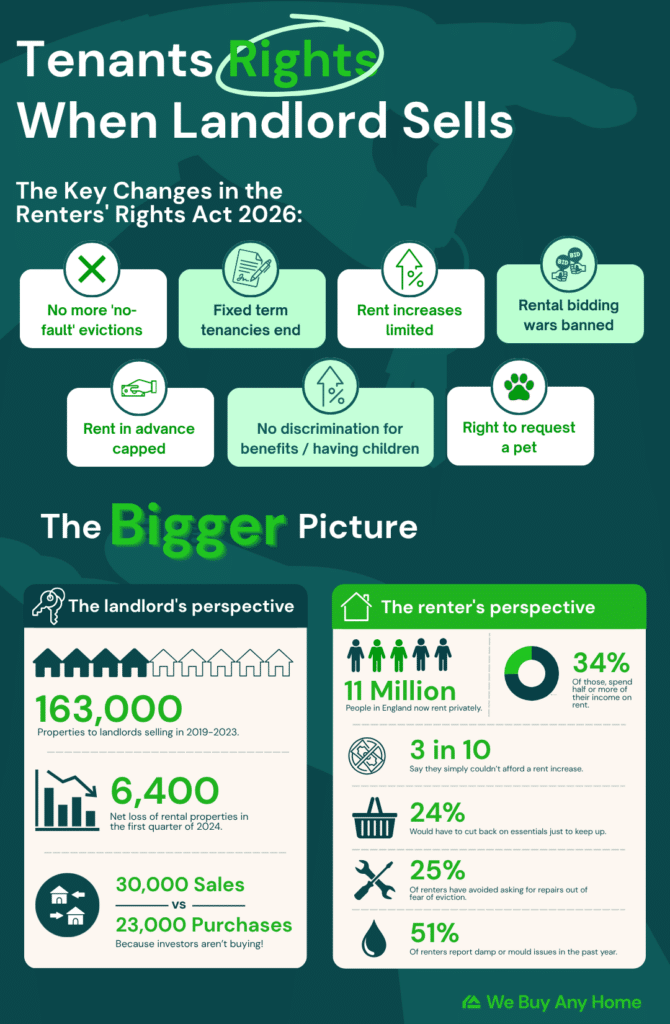
Fixed-term tenancies are a thing of the past, as everything is now periodic. Tenants stay as long as they want and leave with two months’ notice. Landlords, meanwhile, have lost the ability to use Section 21 ‘no fault’ evictions.
That change alone rewrites the dynamic when a landlord wants to sell. You can no longer remove tenants with minimal explanation. Instead, you must use a legal ground for possession – and selling the property is one of them.
Unfortunately, even that comes with strings attached. For the first 12 months of a tenancy, landlords are blocked from evicting tenants on the basis of selling or moving in themselves. That’s a deliberate attempt to stop abuse of the system.
Beyond that first year, you must prove your intention to sell, and give four months’ notice. That’s double the old Section 21 timeframe.
For tenants, it brings an element of security, while for landlords, it’s a considerable constraint.
The numbers behind the UK rental market
Around 11 million people in England now rent privately. Of those, 34% spend half or more of their income on rent. Three in ten say they simply couldn’t afford a rent increase.
Another 24% would have to cut back on essentials just to keep up. Even more concerning, around 25% of renters have avoided asking for repairs out of fear of eviction.
The headline figure you might’ve heard in the past is that over 26,000 households faced homelessness in a single year due to Section 21 evictions. This was one of the most cited reasons for the Renters’ Rights Act being much needed.
Things seem better for tenants – but at what cost?
On paper, tenant rights are stronger than ever. Tenants now have greater security, clearer rights around rent increases, and protection from arbitrary eviction. Rent can only be increased once a year, and it must reflect market rates. If tenants disagree, they can challenge it at a tribunal.
They also have stronger protections around property conditions, due to the expansion of Awaab’s Law. With 51% of renters reporting damp or mould issues in the past year, that change feels overdue.
So, is everything quite as positive as it seems at a glance?
Critics argue that the system is becoming increasingly one-sided. Only 21% of landlords are considered ‘slum landlords’, yet the entire sector is being regulated as if poor practice is the norm.
Landlords are leaving as a result of this. Between 2019 and 2023, the UK lost 163,000 rental properties as landlords sold up. In early 2024 alone, there was a net loss of 6,400 rental homes, with 30,000 sales and only 23,000 purchases by investors.
And when supply drops in a market where demand is already high, rents rise. In fact, as the link above reports, rents have already increased 8% in the past year and roughly 30% over the last four years.
So yes, tenants have more rights. But they’re also competing for fewer homes.
Tenants’ Rights When Landlord Sells
It’s time to say goodbye to the days when abrupt sales from landlords left tenants scrambling. The Renters’ Rights Act now puts tenants squarely in the frame.
As a landlord, if you sell the property you’re renting out, the tenancy continues automatically. Whoever buys your house will simply step into your shoes, with the terms of the rental agreement unchanged.
You’ll need to give tenants sufficient notice about any house viewings, but that’s not a new law.
Your renters also have a right to be told who the new landlord is. They don’t have to pay rent until you’ve provided details in writing.
If you want to reclaim the property to sell it vacant, you must now use a valid section 8 ground and give at least four months’ notice. This is only an option after the tenancy has run for at least one year, too.
The landlord response: exit, adjust, or outsource
Faced with tighter rules, most landlords are reacting in one of three ways.
The first is the most obvious: selling up. For many, the combination of stricter regulation, higher taxes, and reduced flexibility simply isn’t worth it anymore. Selling with tenants in situ is becoming more common, especially when you’re looking for a quick exit.
The second response is to adjust to the circumstances. If you’ve got time to research all the new laws, and understand the ins and outs, it could be possible to make the situation remain profitable. This could involve restructuring your portfolio, increasing rents in-line with market rates, or exploring alternative models like company lets.
There’s also a rising focus on documentation and compliance. With mandatory landlord registration and ombudsman membership now in play, the administrative burden has gone up a lot. Fines can reach £7,000 for a first breach and £40,000 for serious or repeated violations.
As a third option, you might not be surprised to hear that letting agents are seeing renewed demand. Many landlords feel that the situation has become too complex to manage casually.
How does the UK rental market compare globally?
It’s tempting to view these changes as extreme, but in a global context, the UK is still somewhere in the middle.
In Germany, tenants enjoy long-term stability but are expected to handle minor wear and tear themselves. In Denmark, landlords must give three months’ notice for eviction – or a full year if they plan to move in themselves.
France goes even further, banning evictions entirely during winter months. At the other end of the spectrum, countries like Romania allow landlords to evict tenants without grounds or minimum notice.
So, while you could argue that the UK has taken a ‘middle ground’ approach, one of the unique factors working against it is the nation’s housing shortage. Unlike France, where supply is less constrained, tightening landlord regulations in the UK has a direct impact on availability.
When sales get tricky: real-world stories
Selling a property with tenants in situ isn’t the easiest thing in the world. Sometimes, it can become a real nightmare, which may get dragged through the court system. It’s best to avoid this, if possible.
Your tenants have the right to remain in the property until legally required to leave. They also have rights around access. You must give at least 24 hours’ notice for viewings, and tenants can refuse access if that notice isn’t properly given.
Your tenants also aren’t required to stage the property or keep it spotless.
There are cases where tenants delay sales by refusing viewings. As a landlord, you have limited recourse beyond legal channels, which are often slow and costly.
Why letting agents could be the answer…
As tenants’ rights get stronger, and the process of selling a house gets harder, it’s no surprise that more landlords are turning to letting agents as a possible solution.
Letting agents aren’t just middlemen collecting rent and arranging repairs, if you don’t want them to be. You’ll also find letting agents that are compliance specialists, legal buffers, and even negotiators between landlords and renters during a sale.
When viewings are involved, this buffer becomes particularly valuable. Your letting agent can take care of the scheduling, without getting emotional, and ensure you’re complying with rules that you might not have even heard of.
This all gives you financial protection during the selling process, too, because mistakes aren’t being made. And if they are, your letting agent should have indemnity insurance to cover it.
What you need to get right when selling your tenanted house
Selling a tenanted property in 2026 requires careful thought, and attention to detail. You must ensure that you’re using the correct legal grounds for possession, providing sufficient notice, and maintaining full compliance with registration and documentation requirements.
You must also respect tenants’ rights throughout the process, making sure you avoid any behaviour that might be interpreted as harassment or pressure tactics. Deposits must be properly transferred to the new owner, and tenants must be informed of any change in ownership promptly. In short, the margin for error has narrowed significantly.
Meanwhile, there’s no doubt that tenants hold more power – but that doesn’t mean they get unlimited freedom. As a landlord, you must still stand your ground, and ensure that your renters uphold their responsibilities, too.
They are entitled to quiet enjoyment of the property, and they can refuse access without proper notice. They can also challenge eviction notices if they believe the grounds are invalid.
Deliberately obstructing a sale, though, or damaging your property, is still enough to trigger legal consequences.
The most pragmatic approach is cooperation within reasonable boundaries. Agreeing to viewings at suitable times, maintaining basic standards, and keeping communication open tends to lead to smoother outcomes.
What happens next?
When a landlord sells in 2026, tenants are no longer at the mercy of a two-month notice and a vague explanation. They have rights, protections, and a stronger position in the process.
The Renters’ Rights Act is the start of a new era in the UK housing market. So, as a landlord, you need to be prepared for what comes next.
Make sure to do your research and get advice from those at the cutting edge of the sector. It could save you a huge amount of money, and a world of time and stress.