If you’re thinking about selling your flat, it’s important to do some preparation beforehand. This might not sound like the most exciting part – but it’s undoubtedly one of the most important.
Collecting certain documents will make it easier to sell your flat. That doesn’t mean that you can’t sell it if some of these are missing, though.
A prime example is the EWS1 certificate. You can sell your flat without one of these documents. It’ll just be a bit harder to do so.
An EWS1 may be requested by a mortgage lender, valuer, buyer or solicitor, especially where a block has cladding or other external wall materials that raise questions about fire safety.
So, let’s take a closer look at this subject, including what an EWS1 certificate is and when you need one.
What is an EWS1 certificate?
An EWS1 certificate is an external wall system fire review form. It was developed by RICS, UK Finance and the Building Societies Association to help valuers and lenders understand the potential fire-safety risk associated with the external wall system of a block containing flats.
The system was brought in by the Government during the aftermath of the Grenfell Tower fire. Serious concerns were raised about combustible cladding and other materials used on high-rise residential buildings. Lenders became increasingly concerned about whether flats could be properly valued and safely used as security for mortgages.
An EWS1 looks at the external wall system and, where relevant, attachments such as balconies. It isn’t a general fire-safety certificate, nor is it a certificate confirming that the whole building is safe. Your building can meet all EWS1 requirements and still need other fire-safety work or assessments.
When might an EWS1 be requested?
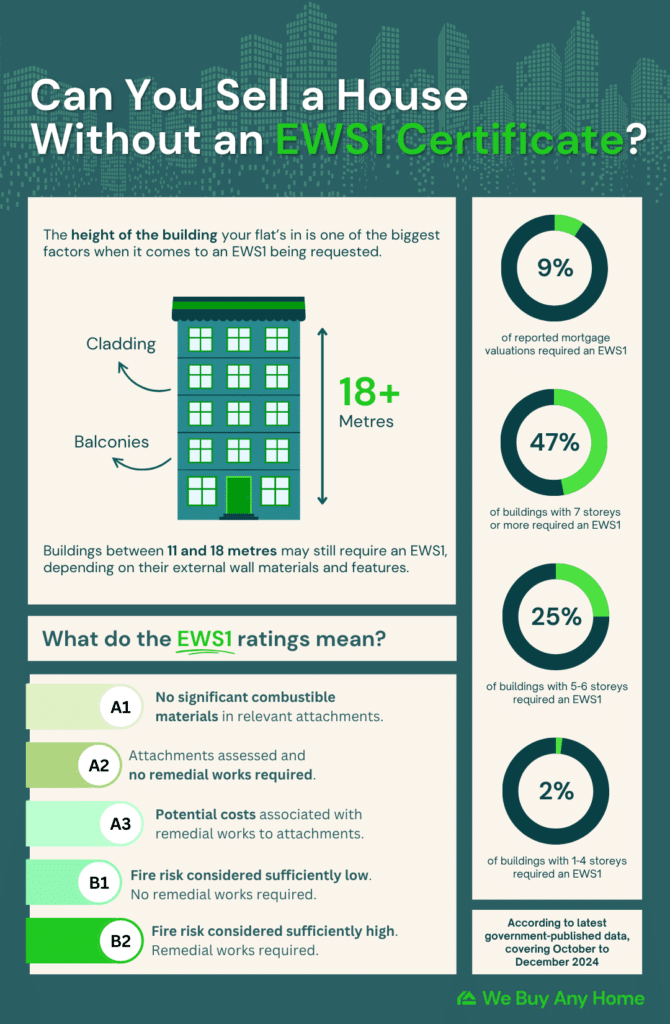
The height of the building your flat’s in is one of the biggest factors, albeit not the only one. This could be one of the pros or cons considered when buyers view a flat.
Historically, the focus has been on buildings over 18 metres with cladding. EWS1 requirements can still become relevant in buildings between 11 and 18 metres, and particular external wall materials, balconies or other features can influence whether a lender or valuer wants further information. The lender’s policy is crucial.
The latest government-published data, covering October to December 2024, found that 9% of reported mortgage valuations for flats required an EWS1 or equivalent.
For buildings of seven storeys or more, however, the figure was 47%, compared with 25% for five- or six-storey buildings and just 2% for buildings of one to four storeys.
This shows that EWS1 forms are not needed for the vast majority of flat mortgage valuations. So, blanket claims such as “all flats over X metres need an EWS1” should be viewed with suspicion.
Who arranges an EWS1?
An EWS1 assessment needs to be dealt with at building level by the building owner, freeholder, landlord or residents’ management company, often with involvement from the managing agent.
This is because the form (and its findings) relates to the entire building, not just your individual flat.
A qualified professional must complete the form. The assessment considers the external wall construction and, where relevant, combustible materials and attachments. The current version of the document gives different outcomes depending on what the assessor finds.
When you’re trying to sell your property, this can create an awkward situation: you may urgently need information about the building, but you may not personally have the authority to commission the assessment.
The sensible first move is usually to ask the managing agent or freeholder whether an EWS1 already exists. This can be quicker than immediately trying to commission your own assessment.
What do the EWS1 ratings mean?
The EWS1 form broadly produces an A or B assessment, with sub-categories.
An A rating indicates that the external wall materials are unlikely to support combustion. A1 means there are no relevant attachments containing significant combustible materials. A2 indicates that an appropriate risk assessment of the attachments has concluded that remedial works are not required. A3 means potential costs associated with remedial works to attachments.
A B rating is used where combustible materials are present. B1 means the assessor considers the fire risk sufficiently low that remedial works are not required. B2 means the fire risk is considered sufficiently high that remedial works are required.
An A1, A2 or B1 result is generally much easier for a buyer and lender to deal with. By contrast, A3 or B2 can raise questions about remediation, funding and who ultimately pays for the work.
RICS and lenders have stated that lending can still be possible where remediation is required, as long as there’s a suitable costed and funded remediation plan with committed dates.
The EWS1 rating could also have an effect on any indemnity insurance you wish to take out, including how much it costs.
How much does an EWS1 certificate cost?
There’s no one-size-fits-all answer to EWS1 certificate cost. The price can vary significantly depending on the size and complexity of the building, the external wall system, the extent of investigation required, the professional carrying out the work, and who commissions it.
What happens if there’s no EWS1?
A buyer purchasing with cash could be perfectly comfortable proceeding without an EWS1 cert. A mortgage buyer, however, may find that their lender or valuer wants additional evidence.
If the lender won’t lend without the form, the buyer might be unable to complete the purchase. They could ask you to wait while the building owner tries to get the necessary assessment, renegotiate the price to reflect the uncertainty, or ultimately walk away.
Even if an EWS1 exists, it could be unfavourable or outdated. For example, if it identifies remediation requirements, further questions can follow.
RICS states that completed EWS1 forms are valid for five years, although individual lender policy should be checked and building owners can commission a new assessment under the relevant guidance.
What should you do if your sale is being held up?
Start by finding out whether an EWS1 already exists for the building. Ask the freeholder, managing agent or residents’ management company. Check whether there’s also other external-wall or fire-safety information that could satisfy the buyer’s lender.
Next, establish exactly what the buyer’s mortgage lender is asking for. Your conveyancer can help with this.
If the open-market sale remains blocked, or likely to fall through, it’s worth speaking to your estate agent.
You could also consider whether another buyer would take a different approach. A cash buyer, for example, doesn’t have the same mortgage underwriting process as a buyer relying on a major lender.
Frequently Asked Questions
What does EWS1 stand for?
EWS1 stands for External Wall System Fire Review. It’s a form used to provide information about the fire risk associated with the external wall system of a building containing flats.
Is EWS1 a legal requirement?
No. An EWS1 certificate isn’t a statutory or regulatory requirement for selling a flat. However, a mortgage lender can decide that it wants an EWS1 or equivalent information before lending.
How long does an EWS1 last?
RICS says completed EWS1 forms are valid for five years, although lenders should be checked individually to make sure they will accept the particular form.
Who pays for an EWS1?
There’s no universal rule that every individual flat owner pays. Because the assessment relates to the building’s external wall system, the building owner, freeholder or management company may arrange it. The contractual and ownership arrangements need to be checked in each case.
Can cash buyers buy flats without EWS1?
Yes. A cash buyer does not need a mortgage lender to approve the property, so an EWS1 may be less of an obstacle. However, the buyer can still ask questions about the building’s fire safety, cladding and future remediation costs.
So, can you sell a flat without an EWS1?
Yes, you can. Whether you can sell it quickly, smoothly and for the price you want, though, is a different question.
An EWS1 isn’t one of the compulsory documents for selling your flat. The available evidence shows that most flat mortgage valuations don’t require one. Although if a lender, valuer or buyer has concerns about the building’s external wall system, a missing EWS1 can create a serious transaction delay.
If you’re stuck with a flat affected by an EWS1 issue, cladding concerns or a delayed sale, it may be worth considering alternatives rather than simply waiting indefinitely for the paperwork to appear.
WeBuyAnyHome may be able to discuss a cash offer for flats affected by EWS1, cladding or other sale-delay issues. This gives you another route to explore alongside a conventional estate-agent sale.