Selling a house is supposed to be an exciting moment. It’s time to cash in on all the equity you’ve built up in the property. You’re moving on to a new chapter, and you want to keep as much of your money as possible in the process.
The reality is a bit trickier than that. When you sell your house, a litany of costs can appear, slowly eating into your profit. Knowing roughly what to expect going into the process is a smart idea.
Sadly, many homeowners only find out how expensive selling is when they’re already halfway through the process.
On average, the cost of selling a home in the UK sits around £8,100. Some of these are up-front costs that you need to cough up before you’ve even received a penny for your house.
So, let’s talk about what selling a home actually costs, which fees you can avoid, and how to be prepared for what lies ahead.
The real price of selling your house
If you ask most people what costs are involved when you sell your house, they’ll probably name two things: estate agent fees and solicitor fees.
Whilst these may be some of the biggest costs, in reality, there’s much more to consider, and you need to be prepared.
Selling a home in the UK generally costs somewhere between £5,000 and £10,000. It varies depending on your property type, your mortgage situation, and how far you’re moving.
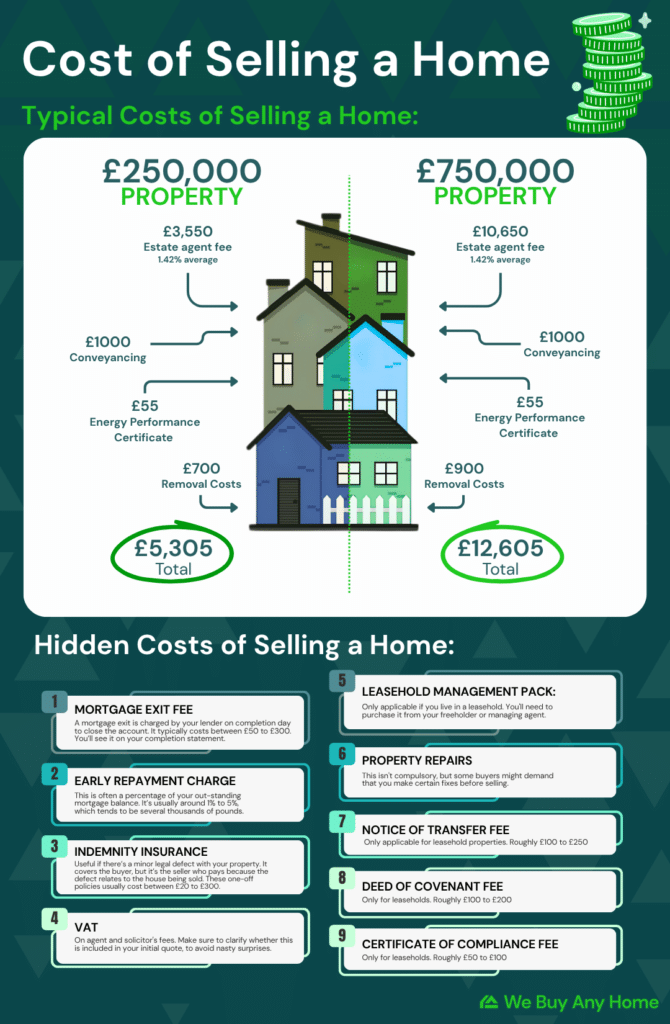
There’s no doubt that one of the largest costs is the estate agent. On average, estate agent commission sits around 1.42%, plus VAT. So, if you sell a home for £250,000, you’re paying around £3,550 in fees, or £4,260 once VAT is added. And if you sell for £750,000? That rises to around £10,650 in fees, or £12,780 including VAT.
Needless to say, this number continues to rise as you head into the millions.
The average solicitor’s fee for selling a freehold property between £200,000 and £300,000 is around £1,000. This can increase considerably once you factor in disbursements, or unexpected issues.
If you need to pay for a new EPC, it will typically cost £65 to £120. Then you’ve got removal costs, with Zoopla estimating that a typical three-bedroom move costs around £800, based on a 15-mile distance. Increase the mileage, and it goes into the thousands.
When you stack those up, you get a total cost that demands plenty of financial preparation. A £250,000 three-bedroom home sale might cost around £5,205. A £750,000 sale costs around £12,305.
On average, Brits sell a house eight times in their lifetime, which means this isn’t a one-off pain. Getting smart now could save you money again and again and again.
Is negotiation ever an option?
Even though there’s so much money on the line, it’s quite rare for Brits to haggle over the costs involved. You might be surprised to hear, though, that not all countries take this same approach.
Admittedly, some fees in the UK home-selling process are non-negotiable. Your EPC has a market price, and your mortgage lender sets their own exit fees. When you’re selling a leasehold flat, your freeholder’s paperwork demands can also be unmoveable.
Yet, several of the biggest costs could be up for negotiation if you handle it right.
Estate agent commission is the obvious one. Some of the smaller companies or independent agents are open to negotiation. Just remember that chasing the cheapest estate agent may not work out in your favour. Shaving 0.2% (for example) off the commission rate is often pointless if your final selling price is noticeably lower than another agent could’ve achieved.
Removal companies are also negotiable, although fewer people realise it. According to a guide from Bourne Moves, negotiation is common, but it has to be done carefully. The cheapest quote may be cheap because corners are being cut, so it’s important to do your research.
One potential move is to take a cheaper competitor quote and ask your preferred company to match it, while staying honest and providing the details. Reputable firmsmay break down why their quote is higher, and in many cases, they could meet you halfway.
Solicitors’ fees can be tweaked if you’re willing to shop around. Get multiple quotes, compare what’s included, and always check if the quote includes VAT.
Ways to reduce your selling costs
The easiest way to reduce selling costs is to avoid unnecessary spending. That sounds obvious, but most people panic-spend during a house sale.
You don’t need to redecorate everything or hire professional cleaners. Whilst some people may want to spruce things up for a sale, these are often changes that go unnoticed in the sale process.
The best strategy is to focus on what buyers actually notice. Minor cosmetic problems are unlikely to collapse the deal. When you’ve got fundamental issues like damp, faulty electrics, broken fences, or a collapsing roof, that’s a far bigger problem.
You should also check whether you’ve got a valid EPC before automatically spending money on a new one. It could save you £65 to £120 and possibly more just by checking paperwork.
Mortgage timing is another huge cost-saver. If you sell during a fixed-rate mortgage period, you often trigger an early repayment charge. This typically sits between 1% and 5% of your outstanding mortgage balance, which can mean several thousand pounds of charges.
You can also reduce removal costs by avoiding peak days and peak seasons. For example, HomeOwners Alliance warns against moving on Fridays because removal companies are busiest and prices rise.
Compare My Move also found clear seasonal pricing differences, with average removal costs rising to around £1,190 in August and November, while February averages around £1,020.
Beware the hidden fees…
You’re probably hoping that we’ve reached the end of all the potential costs that can come up during your house sale. Unfortunately, even when you do everything correctly, a few more hidden fees might appear out of nowhere.
Mortgage exit fees are a classic example. Even if you’re not in a fixed deal, lenders often charge an exit fee to close the account. It usually ranges between £50 and £300, and it appears on completion day (when you least expect it).
Meanwhile, if your property has a minor legal defect, like a missing building regulation certificate for an old extension, your solicitor will recommend indemnity insurance. As the seller, you usually pay for this, even if it’s the buyer who gets protection. These policies usually cost £20 to £300.
If you’re selling a leasehold flat, you often need a management information pack, commonly called an LPE1 pack. It costs around £200 to £500, and you can’t avoid it.
On top of that, your solicitor will sometimes charge a leasehold supplement of £200 to £400 because leasehold transactions are more complex.
Other small fees that occasionally crop up include transfer fees, deed of covenant fees, and certificate of compliance fees. These are only for leasehold properties.
Storage costs are another common problem for sellers. If your sale completes before your purchase, you need somewhere to put your belongings. Temporary storage can cost around £100 to £200 per month, which adds up fast.
And lastly, even after you’ve accepted an offer, your buyer might request repairs. If you decide to go along with this, it can add to your list of fees. Small jobs like damp treatment, a broken cupboard, or fixing a fence can quickly turn into a few hundred pounds’ worth of work.
How selling costs can change by region
It’s natural to assume that the cost of selling a home is exactly the same all over the UK. That’s not quite the case, though.
Removal costs vary massively depending on where you live. Compare My Move estimates the average removal cost in the UK at £1,080, but that figure hides huge regional differences.
Liverpool is one of the cheapest places for removals, averaging £694, which is 45% below the UK average. Newcastle averages £903, Glasgow around £1,001, and Manchester around £1,036.
In Oxford, removals average £1,930, which is 54% above the UK average. West London averages £1,602, and Guildford comes in at £1,573.
Estate agent fees also vary indirectly because house prices vary. The commission percentage stays similar, but the higher the sale price, the more you pay.
There are also leasehold-heavy regions in certain parts of the UK. London and the South East have far more leasehold properties, meaning more sellers get hit with LPE1 packs and freeholder admin fees.
Selling in the UK compared to other countries
It’s impossible to deny that selling a house is expensive in the UK. Yet, comparing the UK system to other countries provides an interesting perspective.
According to Global Property Guide data, selling costs in the UK sit between 2% and 3.5% of the sale price. That’s not cheap at all, but it’s far from the highest.
In Spain, selling costs range from 3% to 6%. France sits between 2% and 5%, while Italy averages around 3%.
Then you see extreme examples. The Philippines comes in at a staggering 10.5% to 12.5%, while South Africa ranges from 5% to 7.5%.
On the other hand, some countries make the UK look expensive. Hong Kong can be as low as 0.5% to 1%, and South Korea sits around 0.3% to 0.5%.
Once you look beyond the costs, though, many argue the UK system is still uniquely slow and opaque. Even in places where the fees are higher, there’s often more speed and transparency when selling a house. Some would consider this a fair trade-off.
Are estate agents facing higher costs, too?
A story from April 2026 in the UK suggests that it’s not just the homeowners feeling the pressure of rising costs. It seems the estate agents are struggling in their own way, too.
Reports have emerged of estate agents launching a £1.5 billion legal claim against Rightmove, alleging that the portal has charged ‘excessive’ and ‘unfair’ subscription fees over many years. Over 250 estate agencies expressed interest in joining the claim, with numbers rising.
The estate agents involved argue that Rightmove dominates the market, so they have no choice but to pay whatever it demands.
According to the claimants, Rightmove operates profit margins of around 70%, reportedly the highest of any FTSE 100 company.
This matters to sellers because these costs get passed on. Estate agents don’t swallow high portal fees – they push up their commission rates, service charges, and sometimes hidden fees.
Here’s why technology could force fees down…
The UK housing selling process has been under pressure for some time. Companies and industry leaders all over the country are looking for ways to reduce hassle and cut costs.
Conveyancing is the biggest bottleneck in the UK house selling process. And according to Collaborative Conveyancing, the integration of AI and data-driven systems that reduce human error and speed up enquiries could be the way to go.
Right now, vital property information such as building control records and highway data often exists in formats that aren’t machine-readable. That slows everything down and drives costs up.
Digitising this information could directly benefit the house sellers. The biggest shift will be shareable property data. Instead of every buyer repeating the same checks, key information can be verified and reused across the transaction.
Single, shareable ID verification will also become standard, which helps to reduce fraud, speed up compliance checks, and remove duplicated admin costs.
Not only could this help sellers financially, but it may also reduce the number of fall-throughs, which is undoubtedly the most expensive scenario for a homeowner trying to sell.
Knowledge and preparation can give you the edge when selling a home
The typical seller pays thousands in estate agent fees, legal costs and removals. There’s then the chances of being blindsided by VAT, mortgage charges, leasehold packs, indemnity insurance, and last-minute buyer demands.
It’s no wonder so many people feel exhausted by the end of it.
However, improving your understanding about hidden fees, how to prepare properly, and where negotiation is possible could put you in a stronger position when the next house sale comes around.