Selling a house is emotional, expensive, and often exhausting. In fact, you’ll struggle to name an event that’s more stressful in life than the months when you’re selling your house.
From unserious buyers to ridiculously low offers, or even total silence on the market, there’s plenty of things that could make you lose sleep.
When you find a way to make this process a tad easier, you should definitely take it seriously. And one of the best ways is by being strategic about when you sell your house.
You’ve probably heard tales that spring is the best time to sell a house, and Christmas is the worst. So, is this true? And does it really have an impact on your final selling price, too?
Let’s get into the importance of timing when selling a property.
The real price of endless waiting
There are thousands of homeowners across the UK who are ‘waiting for the market to improve’. It sounds sensible and strategic at first, but in reality, waiting often turns into months of mental torture.
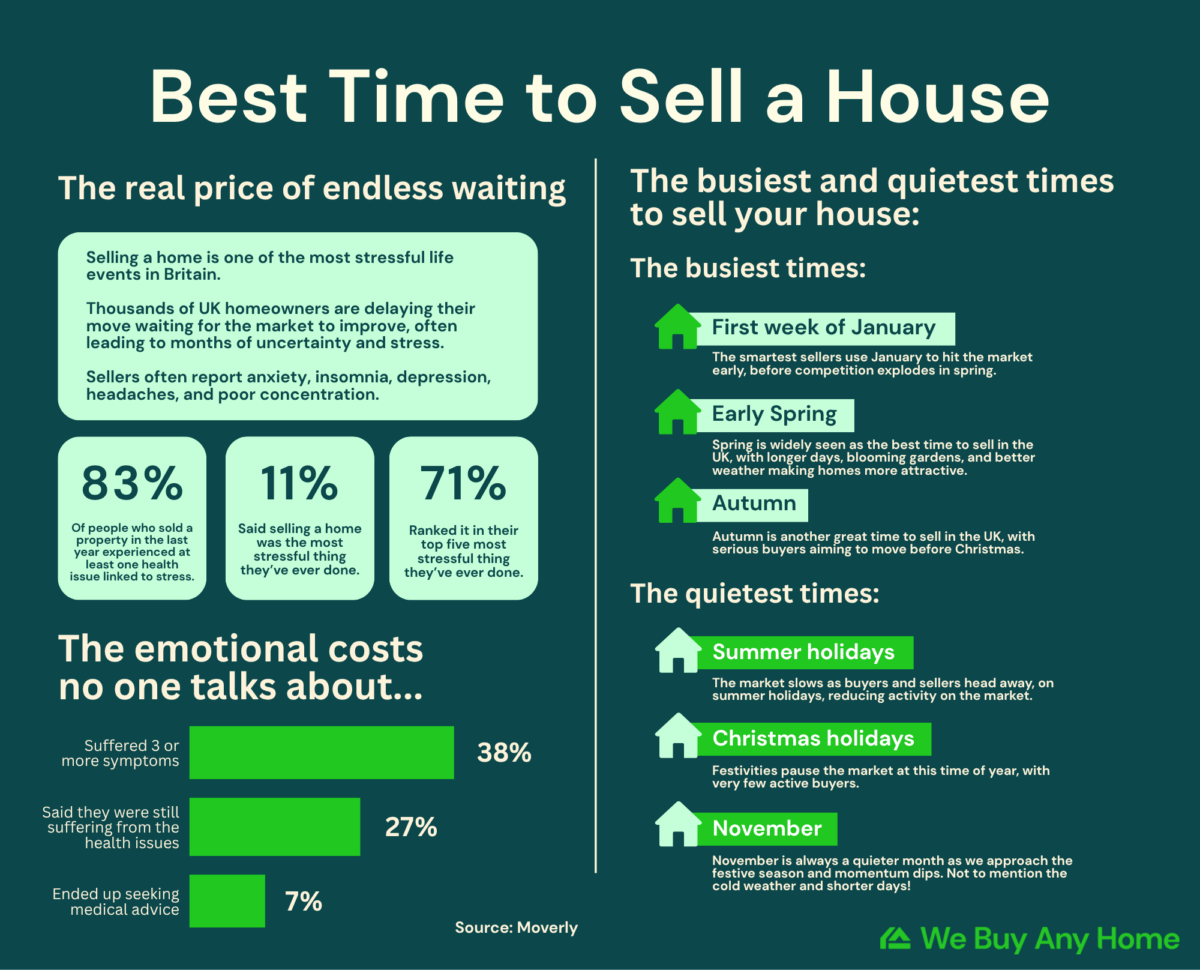
Selling a home is one of the most stressful life events in Britain. A study by Moverly found that 83% of people who sold a property in the last year experienced at least one health issue linked to stress.
Even more shockingly, 11% said selling a home was the most stressful thing they’ve ever done. 71% ranked it in their top five.
Sellers reported anxiety, insomnia, depression, headaches, and poor memory or concentration. A huge 38% suffered three or more symptoms, and 7% ended up seeking medical advice. Even after the sale, 27% said they were still suffering from the health issues the process caused.
That’s the emotional cost no one talks about. So yes, holding off for a better market sounds clever, but the psychological cost is real. For many sellers, the ‘best time to sell’ depends on your personal tolerance for waiting, and how quickly you want to start a new chapter.
Have selling patterns ever changed?
When the property market goes through a spike in activity, it’s rarely inexplicable. It’s usually caused by something tangible, which explains why people suddenly re-enter the market at scale.
In some cases, the main factor is perception. If there’s an atmosphere of positivity about the UK’s economic future, then people may react to this.
Government legislation can also kickstart a change. For example, when the government announced a stamp duty holiday in previous years, it brought thousands of buyers into the market who otherwise would’ve stayed away. Likewise, when stamp duty thresholds are changed (or temporarily reduced), buyers often rush to complete before costs increase, creating short-term spikes in activity.
Multiple sources agree that spring is the strongest selling window. Especially between March and May, when buyer enquiries spike and homes tend to sell faster.
Research shows that spring listings often find a buyer in four to six weeks, compared to eight to twelve weeks in winter. That’s not a small difference.
Autumn is widely perceived as the second big window. September and October often see buyers return after the summer holidays. Hamptons even suggests September to November is one of the two best selling periods of the year. This is because families want to move before Christmas, and the weather still flatters the property.
Meanwhile, summer holidays and Christmas are widely considered the worst times to list. Yet, don’t be fooled by the myth that selling outside spring means disaster – it doesn’t. It just means fewer buyers are looking, so the ones who are looking are either serious or desperate.
It might also mean that estate agents and conveyancers will give you more time and attention. That can work in your favour.
Here’s why you shouldn’t ignore February…
Rightmove has rapidly become one of the leading property voices in recent years. Lots of people trust their judgement – and based on their latest research, February is the best month to sell in the UK.
Their analysis, based on millions of homes sold over ten years, showed that 68.9% of homes listed in February went on to find a buyer. January and March were tied in second at 68.8%, with April at 68.7% and May at 67.7%.
Even October, the ‘worst’ month in their ranking, still saw 65.4% of homes finding a buyer. So, the difference between each month is not enormous. Nonetheless, if you want the tiniest of edges, then February is a month that deserves more of your consideration.
Rightmove also found that January was the quickest month to find a buyer, with homes taking an average of 47 days. February followed closely at 48 days.
So, if you’re waiting for spring to begin – it’s possible that you’re already late.
The smartest sellers use January and February to hit the market early, before competition explodes in March. You catch buyers while they’re still motivated and before every other homeowner decides to do the same.
Price always beats timing
When you read the title of this article, you might assume that timing is the most important detail when selling your house. While it’s one of the most important, there’s something that matters even more: asking price.
Seasonal price variation in the UK is small, typically only 1% to 3%. That means timing your sale perfectly gains you less than most people think. However, if you price it wrong, it can cost you tens of thousands (or more!).
It’s crucial that you stay realistic, and not arrogant. It’s natural to compare yourself to people you know, or houses nearby – but unless yours stacks up favourably against theirs, it’s possible that yours will sell for much less.
Buyers decide the value. And if you’re not getting viewings in the first few weeks, something is wrong – and it’s usually the price.
That’s why sellers who obsess over the ‘best month’ often miss the point. You can list in April, but if you’re overpriced, you’ll still sit there until July, when everyone else has gone on holiday and buyers start offering less.
Getting both your pricing and timing right is the ultimate combination.
How to spot when a market will heat up soon
If you’re getting ready to sell, but aren’t quite there yet, then it might be worth doing some research in the areas where property is about to explode. It could be the ideal opportunity to invest there early. Or, you might be able to apply these same principles to your local area, to predict when the conditions will be perfect.
After all, the UK does not consist of one housing market. Each town is different to the next, and while one town may be booming, another could be struggling.
Look out for local economic investment. This involves new employers moving into the area, regeneration projects, infrastructure upgrades, or new transport links.
International Property Partners points out that a strong clue is a ‘price gap’ between an area and a nearby more expensive location. When people get priced out of one neighbourhood, demand spills into the cheaper one next door.
Infrastructure is another trigger. New train stations, road upgrades, hospitals, and schools all increase demand. But there’s a twist: buyers love the benefit, but not the disruption. A new school on your street creates gridlock twice a day, and that drags your value down. Homes slightly further away, but still close enough to benefit, are in the sweet spot.
If you’re selling in one of these areas, you have two winning strategies: sell now while demand is rising or wait and ride the growth. Your judgement must be spot-on. Perhaps get feedback from local estate agents, too.
When is the best time of day to host a viewing?
When someone views your house, they’ve often made a decision within the first few minutes. It’s crucial that you make a powerful first impression – meaning that even the smallest details, like the time of day, can have an impact.
In spring and summer, evening viewings are popular because the daylight lasts longer, people finish work, and the house looks bright.
In winter, daylight is your best friend. Late afternoon viewings become risky because buyers arrive in darkness and immediately feel the property is gloomy, cold and uninviting.
If you’re selling in winter, your home must be warm and properly lit for every viewing. Lamps and softer lighting work better than harsh overhead lights. Otherwise, it could make your house feel too ‘clinical’. Paths and driveways also need to be clear and well-lit for safety and kerb appeal.
So, even if it means you must adjust your schedule, it could make a world of difference to your viewer. Buyers fall in love with warm, light properties.
Spectacular stories of selling at the right moment
Many house sale stories are dull – but not all of them. And every now and then, timing creates something spectacular. We thought we’d share some of the most extraordinary stories, to emphasise why this is such a crucial area.
The classic example is the housing bubble story. In the mid-2000s, house prices surged to unsustainable levels in the US. People who sold at the top walked away wealthy, while people who held on watched their money disappear.
Meanwhile, when the UK stamp duty holiday ended in 2021, there was a major rush to beat the deadline. In the immediate weeks beforehand, properties sold for £10,000s more than they usually would have, because it made such a big impact.
Another example is when the Elizabeth Line was announced in London. Any town along the line experienced a considerable average price increase. Especially if there hadn’t been major transport infrastructure into London beforehand.
What day is the best to sell a house?
People love to ask what day is best to sell a house. Unfortunately, the real answer to this question is a bit boring. The day you list doesn’t matter nearly as much as the day you complete.
Completions often happen on Fridays because buyers want the weekend to move in and settle. It also suits people taking last-minute time off work.
Yet, because Fridays are popular, removal firms and solicitors are stretched. Midweek completions are less common, meaning bookings are easier and less stressful. That could be a worthwhile trade-off, if you’re able to get the time off work.
The best day to complete is the day that reduces chaos. For example, completing on a weekday could be perfect if your children are at school, because it means you can pick them up at the end of the day and take them to their new home.
As for listing days, the bigger factor is when buyers browse. That tends to be early week and weekends, because people are bored at work or procrastinating on Sunday evenings.
Just remember that a well-priced home sells, regardless of the day.
Life milestones to avoid when selling (unless you have no choice)
The property market doesn’t pause for your personal life. Yet, there are certain milestones that can come at the worst possible time and create a ‘perform storm’ if you’re trying to sell your house as well.
Divorce is the obvious one. Selling under pressure leads to rushed decisions and bitter negotiation, especially if you’re not on the same page as the person you’re selling alongside. You may find yourself focused on ending the chapter as fast as possible.
Bereavement is another. Probate sales are common, but grief makes the process heavier. This is tricky when families disagree, or people attach enormous value to memories.
Having a baby is also challenging. You’ll be sleep deprived and stressed at the best of times. Combine it with a house move, and you’ll need an iron will to get through it.
Job changes are another major trap. If you’re starting a new role, your attention is split, and house selling requires constant admin, calls, emails, and document chasing.
If you can avoid any of these big life milestones, then make sure you do. You’ll have a difficult enough time already – you don’t need to make it worse. Of course, not everyone has the luxury of controlling these things. You may just need to bite the bullet, and perhaps ask loved ones to help you out.
Best Time to Sell a House UK
Here’s the honest answer: the best time to sell your house in the UK is when you are prepared, realistic on price, and ready to move quickly.
Spring remains the strongest season, especially March to May. Autumn is a close second, particularly September and October.
February is a dark horse for selling your property, and Rightmove certainly thinks that it deserves more attention. And if speed matters, January is the fastest month to find a buyer, averaging 47 days.
If you’re waiting for perfection, then you might be waiting a long time. The market rewards decisive sellers who understand the local area, price properly, and prepare early. Make sure that’s you.