Choosing your estate agent feels like a big decision. When you’re selling such an expensive asset, you want to achieve the best price possible – and the right estate agent will make that possible.
If you get this choice wrong, though, it can have the opposite effect. This makes it important that you ask lots of questions before making your decision. Here’s an in-depth guide on 10 questions to ask estate agents when selling.
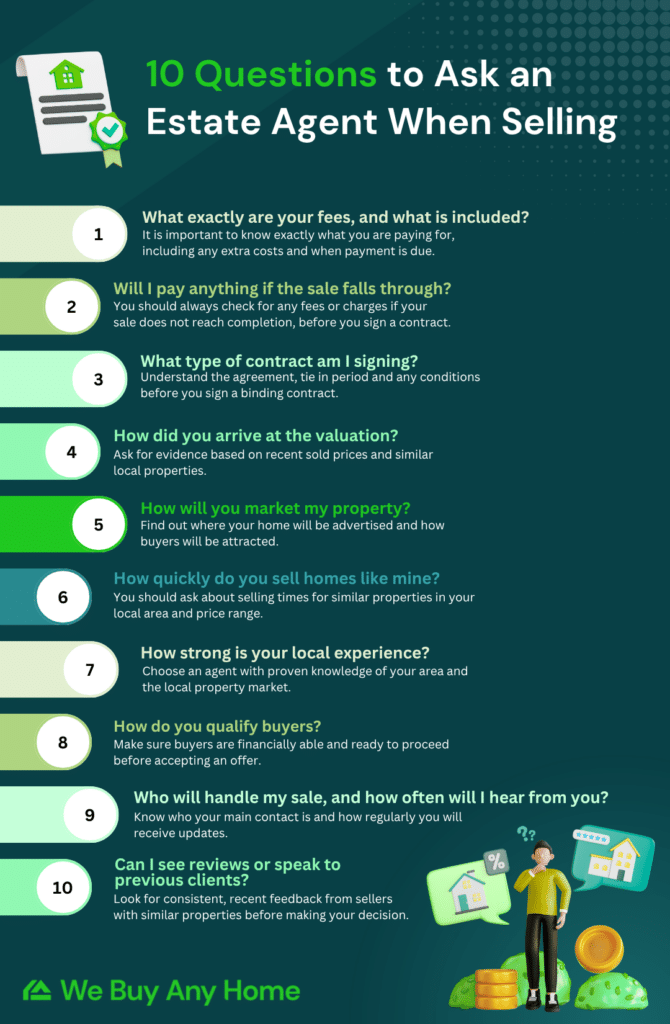
1. What exactly are your fees, and what is included?
Estate agent fees shouldn’t be unclear. Before choosing an estate agent, ask what they charge and whether it’s a percentage commission or a fixed fee. You also need to know whether VAT is included and when payment is due.
Most high street agents charge a percentage of the final sale price, usually payable on completion. Online or fixed-fee agents may charge upfront, which can look cheaper but means you may pay even if the property doesn’t sell.
Get clarity on what’s included – such as floor plans, photography, a ‘For Sale’ board, and portal listings. Make sure there are no hidden fees waiting down the line, either.
2. Will I pay anything if the sale falls through?
Sadly, not every sale completes. You should consider this when choosing questions to ask an estate agent when selling your house.
If your agent works on a no-sale, no-fee basis, you usually only pay their commission when the sale completes. You should still check for withdrawal fees, marketing charges, admin costs or upfront payments, though.
These are separate from conveyancing costs, where your solicitor may charge for work already carried out even if the sale falls through.
3. What type of contract am I signing?
Estate agency contracts can sound dull, but you need to pay attention to them. This should be one of your first estate agent questions. Ask whether the agreement is sole agency, sole selling rights, joint agency or multi-agency.
The type of contract determines when your estate agent receives their commission. It also impacts the termination terms for walking away from the contract.
You may even want to get multiple estate agents to represent you, although not everyone agrees that this is an effective strategy.
When reviewing the contract, a four to twelve-week tie-in may be normal, but longer tie-ins should make you pause. For example, you should rarely agree to giving your estate agent a six-month contract.
4. How did you arrive at the valuation?
Ask for comparable sold prices, not just asking prices. There’s a big difference between what sellers hope to get and what buyers actually paid.
A sensible valuation should be based on recent sales of similar homes in your area. It will also consider the current market and your property condition.
You should find out what homes like yours the estate agent has sold recently. Then get details on the selling price, versus what it was listed for.
Make sure your estate agents are realistic and honest in valuations. If there are any signs they might be selling you a dream, it’s important to question this.
5. How will you market my property?
Ask exactly where your property will appear, which portals (e.g. Rightmove, Zoopla) they use, whether they already have database buyers, and how they will present your home.
Photography, floorplans, and the property description will all play a big role.
You should also ask about the viewing strategy. Will they conduct viewings, or will you? Will viewings be grouped to create urgency? Will they recommend a ‘For Sale’ sign? Will they use social media, email alerts, brochures or premium listings?
You should be able to tell quite quickly whether your estate agent has a clear plan.
6. How quickly do you sell homes like mine?
Ask how quickly the agent sells similar properties in your location, property type and price band. Ask what their average time is from listing to offer, and from offer to completion.
Average selling times are useful only if they relate to homes like yours. For example, a flat in Manchester, a family house in Kent and a rural cottage in Devon are completely different propositions.
An effective agent will talk about current market conditions. Be cautious of anyone promising a quick sale at a dream price without evidence. House-selling doesn’t work like that, even if we wish it did.
7. How strong is your local experience?
Ask your estate agent how many homes they’ve sold nearby and what buyer demand is like. To make sure they’re well-informed, get clarity on which streets or property types are moving fastest and whether they already have qualified buyers in your area.
This is especially important if your home has something unusual about it, such as a short lease or non-standard construction. The right agent should know how to position it.
8. How do you qualify buyers?
An offer is only useful if the buyer can proceed. Ask how your estate agent checks affordability, mortgage position, deposit, chain details and seriousness.
Don’t forget, a weak buyer can cost you months. You may take your home off the market, turn away other interest and spend money on solicitors, to then discover the buyer was never in a strong position.
A smart agent understands when a buyer is reliable and when they aren’t.
9. Who will handle my sale, and how often will I hear from you?
It’s crucial to understand who is handling your sale. Sometimes, the person who values your home may not be the person answering calls, chasing buyers or progressing the sale.
Ask who your main contact will be, how often you will get updates, and whether feedback from viewings is given promptly.
10. Can I see reviews or speak to previous clients?
Reviews are useful, but don’t rely on one glowing testimonial or one angry rant. Look for patterns in what past customers are commenting on.
You could also speak to a previous client over the phone. This allows you to get the consumer’s perspective, rather than an estate agent telling you what you might want to hear.
Red flags to watch for
There are some warning signs you shouldn’t ignore. Check your contract for vague estate agent fees and long tie-ins. You also shouldn’t feel pressure to sign immediately.
If your estate agent gives unrealistic valuations, weak marketing plans, poor local evidence, or reluctance to put promises in writing, it’s advisable to walk away.
What to compare after each valuation
It’s tricky to know what questions to ask estate agents when selling. So, to make it easier to sort through your notes, compare the same things side by side afterwards.
This includes the fee, whether VAT is included, contract flexibility, and the tie-in period. You should also look at valuation evidence, marketing quality, local track record, buyer database, and the marketing plan.
The best choice is rarely just the ‘cheapest’ or ‘highest valuation’. You need an estate agent who is realistic, honest, and fills you with confidence.
Should you consider a cash buyer instead?
For many sellers, the open market is the best route because it gives the chance of achieving the highest price.
Not every seller has the luxury of time, though. If speed, certainty or avoiding estate agent fees matters more than squeezing every last pound from the market, a cash buyer may be worth considering.
This can be suitable if you’re facing a chain break, relocation, or an inherited property. It may also help if you’re under financial pressure, have difficult tenants, or your home needs work.
Make sure to consider all options before choosing what suits your sale best.
Frequently Asked Questions
How many estate agents should I speak to?
Ideally, it is advised to speak to at least three. This gives you a better feel for valuation, fees, marketing and personality.
Should I choose the agent with the highest valuation?
No, not necessarily. Ask for evidence before proceeding with the agents offering the highest valuation.
Can I negotiate estate agent fees?
Yes, often fees can be negotiated. Many sellers negotiate, especially on sole agency agreements. Just ensure that a lower fee still covers all of the essential services needed to sell effectively.
What is a tie-in period?
It’s the minimum time you’re committed to an agent before you can leave the contract. Always check how long it lasts and how much notice you must give.
What should I ask before signing an estate agent contract?
You should ask about fees, VAT, extra costs, contract type, and sole selling rights. It’s also worth asking about tie-in periods, marketing, withdrawal fees, communication, and what happens if the sale collapses.
Ask probing questions – and take your time!
The best estate agent questions are the ones that get clear answers. You shouldn’t be timid or cautious when there’s so much money on the line.
If you’re still weighing up whether to use an estate agent or want a faster, more certain option, you can start by getting a no-obligation cash offer.
Visit Get My Cash Offer to see what your property could be worth, or read more on the Sell House Fast page.