If you’ve bought or sold a home, you’re probably acutely aware of how challenging conveyancing can be.
It can turn even the calmest homeowner into a muttering, paperwork-shuffling wreck, as they deal with:
- Weeks of silence
- Inexplicable delays
- Missing documents
- Solicitors who take days (if you’re lucky!) to get back to you.
And more.
These can all seriously impact the time it takes to sell your house.
However, it is a crucial legal procedure. Your house sale would be in serious jeopardy without conveyancing being done correctly.
It has dozens of subcategories, from searches, to mortgages, to planning permission, and even transferring deposits… and more.
Read on to learn more.
Conveyancing: Definition
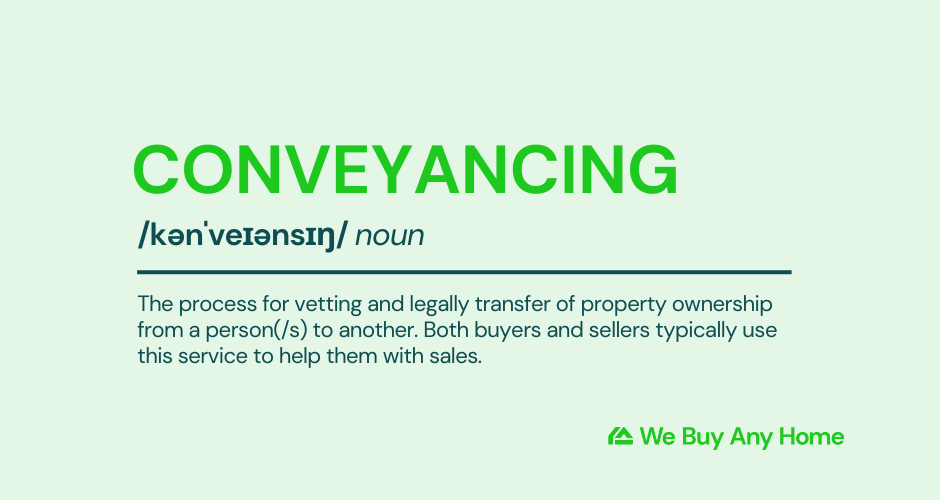
Conveyancing refers to the legal transfer of property ownership from a person(/s) to another.
Both the buyer and seller will typically use this service to help them with the sale.
Each party can do this themselves by getting the relevant paperwork from legal stationers. However, in practice, most people use a conveyancer or – more commonly – a solicitor.
(The same professional can represent both parties – but this is rare).
Conveyancing costs
Conveyancing costs vary depending on the value of your property and whether there are any issues that require extra work, but you can expect to pay between £400 and £1,500 for conveyancing to sell your home.
On top of this there are charges, known as disbursements, for administration such as:
- Copies of title deeds
- Anti-money laundering checks
- Bank transfers.
If you are buying a home as well this will increase these costs, potentially doubling them.
There is usually more legal legwork involved in buying a property and more costly disbursements such as local authority searches and changes to title deeds. Buyers may also have to pay stamp duty.
Conveyancing crisis: The numbers are getting worse…
A quick glance at the statistics reveals the full extent of Britain’s conveyancing crisis.
The average time involved is much longer than it was a decade ago. Today, the numbers are:
- The average time between offer and completion has ballooned to 4.7 months
- One in nine transactions drag on for over six months
- Only one in five completes in under five months.
Furthermore, around 25% of homeowners admit that they struggled to work out what was going on, during the conveyancing process.
This often happens when you feel left in the dark, without a peep from your conveyancer. That’s why the communicative ones are worth their weight in gold.
Common conveyancing complaints
The organisation that stays busy from all these failed conveyancing journeys is the Legal Ombudsman.
Almost 50% of conveyancing complaints are related to a solicitor not giving sufficient advice or following instructions.
Meanwhile, delays and ambiguity over cost equates to almost 33% of complaints.
Astonishingly, 12% of buyers say the ‘fixed fee’ they were quoted bore no resemblance to what they actually paid.
Varied volumes
Meanwhile, according to data from the Land Registry, not all the conveyancers are ‘in it together’.
Some conveyancers receive 83 times as many queries as others. And in recent years, official requests to correct or clarify paperwork have varied by an alarming 8,176%.
Each of these requests can add three weeks of delay.
Add this up over an entire property chain, and you’ve got a nightmare on your hands.
The blame doesn’t lie with a few ‘bad apples’ on the conveyancing side – it’s the outdated processes and staggering inconsistency that create the chaos.
Chaos and comedy: real stories from the frontline
If the statistics show the scale of the problem, the stories show its human cost.
And you’ll scarcely believe some of the wild, extraordinary anecdotes around conveyancing failures.
2021’s big conveyancing shutdown
In 2021, a dramatic incident hit the front pages, when a security incident paralysed the systems of many of the UK’s largest conveyancing practices.
Thousands of transactions froze overnight.
In one case, homeowners had already paid £1,000 to move their belongings out in anticipation of completing.
Their exchange date came and went – as their conveyancers temporarily vanished behind the digital blackout.
The timing couldn’t have been worse: October and November, just as people rush to finish before Christmas. The system wasn’t restored for over a month.
Deputy Prime Minister’s conveyancing scandal
Then there’s the political fiasco involving Angela Rayner, who found herself embroiled in a £40,000 unpaid stamp duty scandal linked to an £800,000 Brighton flat.
She claimed her conveyancers advised her on the arrangement – but they argued she used them as a ‘scapegoat’, because they hadn’t advised her at all.
Rayner resigned as Deputy Prime Minister over what ultimately began as a conveyancing issue.
YouTuber’s nightmare solicitor
Farah Raja is a YouTuber who was buying her first flat in the UK when her solicitor:
- Demanded cash payments upfront
- Failed to meet deadlines
- Ignored correspondence for weeks
- Didn’t provide search results
- Sent miscalculated deposit requests via text message
- Missed a Help to Buy bonus worth £1,000.
Completion only happened because Farah coordinated directly with the seller herself!
Stories across the UK
Away from the media headlines, thousands people’s lives being negatively impacted by conveyancing problems.
One couple ended up spending Christmas in a caravan because their solicitor’s accounts were frozen by regulators just before completion.
Another homeowner, Miss F, later discovered the leasehold on her apartment did not include the attic room she’d been using. The room belonged to someone else!
Welcome to the world of a Conveyancer…
Most conveyancing problems are not caused by conveyancers.
There are rogue professionals who don’t fulfil their duties. But this is the same as any other profession.
The truth is, it’s the system that’s letting everyone down – including the conveyancers themselves.
Despite the stereotype, most solicitors aren’t lounging on a beach ignoring your emails.
They’re juggling dozens – sometimes hundreds – of files at once. Their firms rely on high volumes of caseloads to make profit.
Conveyancers are also at the mercy of:
- Local authorities
- Lenders
- Surveyors
- Managing agent
- The Land Registry.
Just one squeaky wheel can bring the entire thing to a halt. This might be as simple as a misspelled middle name, or something more serious, like a missing consent for a decades-old loft conversion.
Solicitors’ duties
And a common misunderstanding is that your solicitor only works for you. Believe it or not, they’re also obligated to protect the interests of your lender.
So, if you’re unable to afford the mortgage – then this will often be flagged up, and brought to the lender’s attention.
The full conveyancing process is as rigid and outdated as you can possibly imagine. One unresponsive solicitor in a huge chain of transactions can destroy it for everyone.
Blame games
This tends to create a ‘blame game’ behind the scenes, as each party points the finger at someone else. That doesn’t do much for your nerves, though, nor your patience.
Still, none of this excuses poor communication, incomplete advice or sloppy paperwork.
Consumers aren’t wrong to feel let down. Being left without updates for days or weeks is one of the biggest reasons buyers lose faith in the process.
And the statistics back this up: in a major survey, 29% of people blamed delays on their solicitor’s lack of proactivity – more than any other factor.
In other words, the system is undoubtedly hard work for solicitors, but it’s pure agony for the customer.
British conveyancing vs conveyancing abroad
When you’ve spent your whole life in the United Kingdom, it’s natural to think that ‘this is how it’s always been’.
Yet, just a quick glance across the English channel, or over the Atlantic, and you’ll find lots of countries with a far better system than ours.
- In Norway, the entire home buying process – searches, contract, and completion – often only takes a few weeks.
- In Australia, buyers and sellers use streamlined online platforms with mandatory timelines.
- In parts of the United States, escrow agents handle the bulk of work, and electronic filing is the norm.
Meanwhile, Britain has conveyancers arguing over missing signatures, lenders declining solicitors because they’re not on their ‘panel’, and buyers still posting physical documents because a digital version is unacceptable.
The Land Registry is changing
Slowly, and painfully, the Land Registry system is trundling towards digital modernisation.
This is long overdue – and even now, it’s taking far longer than most people think is right.
British culture seems to involve clinging to ancient workflows out of habit, caution, and fear of fraud – even though other nations have proven there’s nothing to be worried about.
For Britain to fix its conveyancing chaos, it needs to stop tinkering at the edges. Mandatory digital workflows are crucial, along with time-bound search results.
Real-time communication logs should be accessible to all parties, and there must be proper consequences for conveyancers with repeated service failings.
How to pick your conveyancer (without losing your sanity!)
You’ve got no shortage of options when the time arrives to choose your conveyancer.
From high street companies to online professionals, and even the few firms that offer ‘no completion, no fee’ (read the contract carefully!) – choosing the right solicitor is crucial.
But homeowners routinely pick based on price alone, unaware of the risks.
A good conveyancer is proactive, realistic, and honest about timelines. Their fees should be transparent and they shouldn’t overpromise.
You will never be asked for cash up front, and they should already be on your lender’s panel.
Responses will be prompt from day one – if they’re slow from the beginning, run like the wind! – and they’ve handled your type of property before.
As a first-time buyers, especially, you should ask pointed questions:
- Will you claim my ISA or Help to Buy bonus?
- What’s your average completion time?
- How many cases are you handling right now?
- How will you update me?
- Who will actually be doing the work?
The right solicitor can make conveyancing feel manageable. The wrong one can turn it into a nightmare.
Tips to keep your heart rate down
There’s no magic wand when it comes to conveyancing – but there are a few ways to lessen the pain.
Preparation is your secret weapon. Having your documents ready on day-one means that you won’t be responsible for unnecessary delays. You should also respond quickly to any requests that come in.
Get your anti-money-laundering checks done early. Make sure your ID matches exactly across documents – as even a missing middle name can raise eyebrows. Organise your finances so deposits and funds are ready to send without delay.
And if you’re selling, gather all the documents you need to sell your house, including:
- Warranties
- Planning permissions
- Guarantees
- Service-charge statements
- Deeds.
Try to keep communication open with your solicitor. If you’re worried about delays, have an honest conversation at the beginning.
The best solicitors appreciate clarity – and the worst will at least know you’re paying attention.
British conveyancing: a system past its sell-by date?
Conveyancing, at its core, is meant to protect one of life’s most important purchases.
But the British system has become weighed down by inefficiency, uneven quality, and a reliance on outdated practices that do little to protect consumers from stress, confusion, and financial risk.
Buyers and sellers deserve transparency, speed, and consistency.
This has been achieved in dozens of other countries – so it feels frustrating that it hasn’t been done on home soil.
Reform is a necessity, and the British government is slowly coming to terms with that.
The public appetite for digital solutions is already there: seven out of ten homebuyers say they prefer fully digital conveyancers.
Meanwhile, nearly 50% are comfortable with AI conducting ID checks, and a growing number are open to automated updates and chatbot support.
Until we break from the past, conveyancing will remain one of the most painful aspects of buying or selling a house.
It doesn’t have to be that way forever, though – and as customer satisfaction continues to fall, it seems inevitable that change is on the horizon.
Sell your house with We Buy Any Home
We Buy Any Home is the UK’s largest cash house buyer.
We can sell your house in any condition without you having to pay an estate agent or conveyancing fees.