Market conditions impact how easily and how quickly you can sell your house.
In a slow market, simply selling your house is difficult, let alone selling it fast…
But there are steps you can take to sell you house faster – even in challenging market conditions.
Defining a ‘slow housing market’
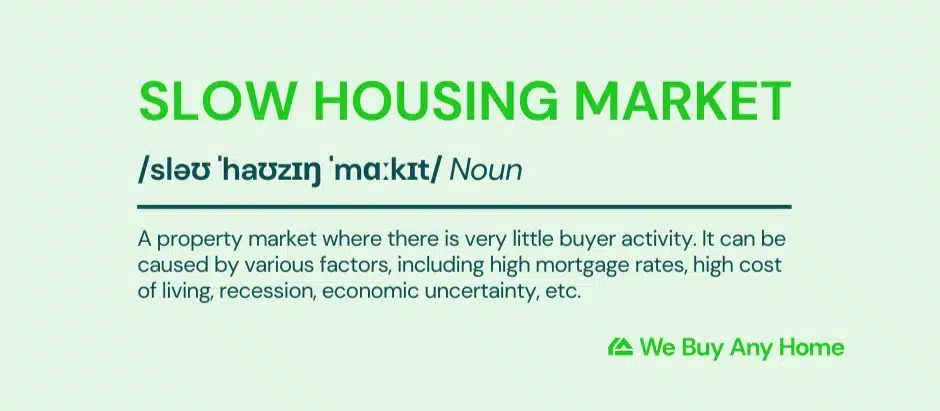
A slow housing market means that there is very little buyer activity.
This can be caused by several factors, including:
- High mortgage rates (which make buying a house more expensive)
- High cost of living
- Recession or economic uncertainty
Understanding slow property markets in the UK
You’d be amazed at how many people list their house ‘For Sale’ without any idea what the market conditions are like.
This isn’t the best approach. Instead, you need to keep one eye on the market at all times if a sale is in your near future.
Economists tend to divide the housing cycle into four stages: Boom, Downturn, Slump and Recovery. A full cycle can last anywhere between 7 and 18 years, which is why so few people notice when they’re repeating old mistakes.
In a Boom, prices soar, buyers queue around the block and estate agents act as if they’re auditioning for ‘Selling Sunset’. Everyone suddenly believes they’re a property genius.
Then comes the Downturn. The shine starts to fade, as buyers hesitate and price growth slows down. Investors are getting ready to pounce.
The Slump is where sellers suffer the most. Prices will either fall, or heavily stagnate. Listings can sit for months and rental demand rises as buyers refuse to commit.
In this situation, panic is extremely common, and homeowners can do some strange things when they’re under pressure.
Eventually, Recovery emerges. Interest rates fall and jobs stabilise, which means that the UK (or elsewhere) citizens start to feel more confident.
Signs that you’re in a slow market…
Slow markets are rarely announced on the nightly news until you’re already several months into it. They tend to creep up on you. So, it’s crucial that you’re aware of the looming signs.
Less viewings
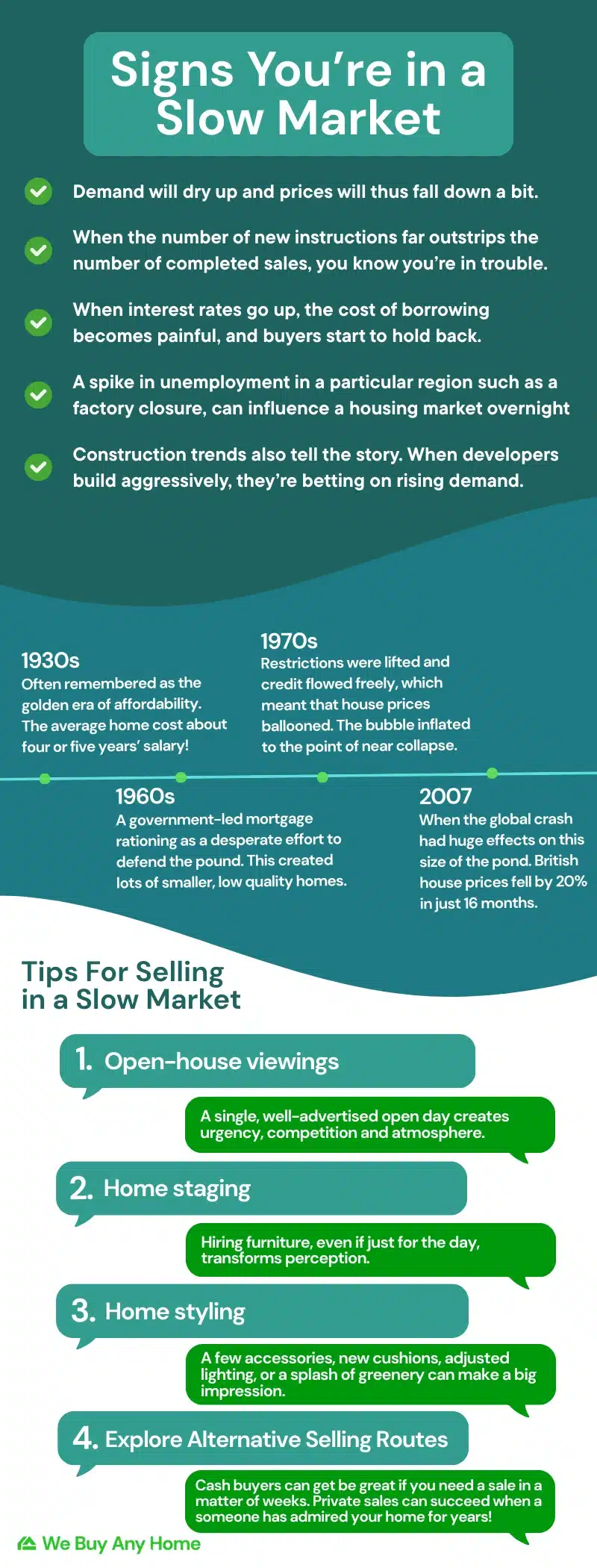
To start with, demand will dry up and prices will thus fall down a bit.
Sellers will get less house viewings. Of course, part of this can be counteracted by marketing your home for sale better, but this isn’t always enough.
Time to sell house increases
Properties take longer to sell than they might’ve done a few months ago.
When the number of new instructions far outstrips the number of completed sales, you know you’re in trouble.
(It is worth understanding how long it takes to sell a house on average and what goes into the process to be certain of this sign.)
Interest rates
Interest rates are another powerful indicator. When interest rates go up, the cost of borrowing becomes painful, and buyers start to hold back. Many will wait until interest rates fall a bit before re-entering the market.
Employment rates
Employment shifts are powerful indicators as well. A spike in unemployment in a particular region – such as a factory closure, or corporate downsizing – can influence a housing market overnight.
This applies on a national scale: mass recession or unemployment affects almost every corner of the UK.
Property building rates
Construction trends also tell the story. When developers build aggressively, they’re betting on rising demand. When they slam on the brakes, they’re anticipating a slowdown.
And then there are the headlines. Even if these are fictional, they usually influence consumer feeling, which impacts how people behave.
Slow markets hardly ever arrive without warning. The problem is that most sellers don’t want to believe the signs. Denial is far more comfortable in the short-term.
A snapshot through Britain’s slowest markets
Slow markets are not a new phenomenon. And even if it feels like ‘the country’s economy is getting worse’ – that may be true, but you’re certainly not the first generation to feel this way! The history of UK homes includes many instances of slow markets.
The 1960s saw government-led mortgage rationing, not out of housing policy but as a desperate effort to defend the pound. This created lots of smaller, low quality homes as builders were squeezed on pricing.
The 1970s then swung the pendulum the opposite way. Restrictions were lifted and credit flowed freely, which meant that house prices ballooned. The bubble inflated to the point of near collapse – although, luckily, it was saved by enormous inflation.
The 1930s are often remembered as the golden era of affordability. The average home cost about four or five years’ salary. But this was an anomaly. For the 80 years before that, housing was wildly unaffordable. 90% of people rented in the second half of the 19th century.
One of the most notable crashes in recent times was in 2007, when the global crash (triggered in America) had huge effects on this size of the pond.
When so many lenders in the UK are owned by foreign companies, it’s inevitable that foreign events can create a huge tidal wave here.
And in 2007, British house prices fell by 20% in just 16 months. It took six years for values to recover – and Northern Ireland has still not returned to pre-crisis peak levels.
So, if history teaches you anything, it’s that Britain is never far from its next slowdown. They arrive with regularity, shaped by forces larger than individual sellers can control. Which is why the smartest sellers focus not on fighting the market, but mastering it.
Is it possible to sell quickly in a slow market?
If you think that all housing markets are the same, and it shouldn’t change your approach to selling, then we’re here to tell you… that’s not true at all. In our humble opinion, it’s crucial that you adjust your approach based on external factors.
Everything must be sharper in a slow market: your pricing, your presentation, your agent, and your strategy. And, above everything else, you need to be realistic.
The number one rule is brutal honesty. The market does not care what you ‘feel’ your home is worth. If you fall into that trap, you’ll be in the same property 12 months later without any offers on the books. Sellers who cling to fantasy prices are the first to fail.
Your estate agent becomes your ally, or your downfall, so you need to choose carefully.
Firstly, honesty is always the best policy. If they’re only trying to flatter you, it means you miss the important messages. You’ll both be head scratching when you struggle to sell – but we won’t be! The right agent will tell you the truth, however uncomfortable.
You need to pay even closer attention to your visuals. Photos matter more than ever in a slow market, as does your curb appeal. Buyers will scroll past bad photos.
And if you’re trying to stand out in a crowded market, think about lighting, staging, rented furnishings, colour palettes and camera angles.
Buyers can smell desperation from a mile away in a slow market. Indeed, the assumption is that all sellers are desperate – so you need to prove that that doesn’t apply to you!
Don’t over-explain, over-justify, or apologise for pointless things. Once you appear desperate, the offers you get will drop like a rock. Remind your estate agent about this when hosting their viewings, too!
Staying calm, confident and communicative is essential. You want buyers to feel they’ve discovered a well-maintained, well-presented, sensibly priced gem. Not that they’ve stumbled into someone else’s crisis.
Unique strategies to stand out from the crowd
Slow markets demand creativity. This is where you separate the crafty buyers, from the inexperienced ones. Competition is fierce, so get ready.
One powerful method borrowed from the USA is open-house viewings. A single, well-advertised open day creates urgency, competition and atmosphere.
Instead of waiting for sporadic individual viewings, you turn the event into something buzzworthy.
Home staging is also overlooked by lots of UK homeowners. Hiring furniture, even if just for the day (and then stacking lots of viewings back-to-back) transforms perception.
Most buyers lack imagination – they need to see a room’s potential, not stare at an empty space, nor lots of clutter.
Home styling is surprisingly effective too. A few accessories, new cushions, adjusted lighting, or a splash of greenery can make a big impression. You may want to get the opinion of an interior design – they could think of suggestions that’ve passed you by.
Ways to sell faster in a slow market
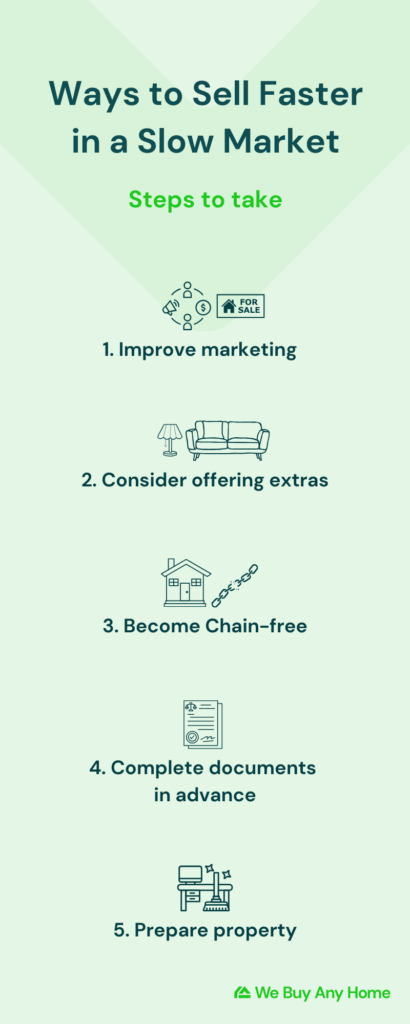
1. Improve your property’s marketing
Good property marketing is an essential part of securing a sale.
Aside from listing with local and/or online estate agents, there are many ways to raise awareness that your property is for sale, including:
- List your house on local magazines and websites
- Put a ‘For Sale’ sign outside your house
- Host Open Viewings that anyone can attend
- Post about the house sale in local Facebook groups
- Contact local property investors
Sometimes, you must be creative and ‘outside the box’ to sell your house in a slow market.
If you do what everyone else is doing, your results will be the sam. And you could be waiting up to a year (or longer) to find a suitable buyer.
2. Find ways to negotiate on price and ‘sweeten the deal’
In an ideal world, you would get an excellent price for your house and make a substantial profit.
But this is rarely possible when forced to sell in a slow market.
If you are open to negotiation, you will gain a wider choice of buyers.
If there are many sellers on the market and few buyers (i.e., ‘a buyer’s market’), buyers hold the power.
It would help if you kept your difficult position private from potential buyers.
For example, keep negative points about your selling process private – such as low viewings or your property being on the market for a long time.
Your negotiating power diminishes when you reveal these details.
You should also think about ways to sweeten the deal for potential buyers.
For example, can you include some – or all – of your furniture in the deal to make your asking price more palatable?
Or you could offer to cover the cost of their survey or legal fees.
3. Find a way to become chain-free
If you are still trying to complete a sale, then everyone else is probably, too…
This increases the likelihood that a chain will break down.
Therefore, if you are a chain-free seller, buyers may view you more favourably and decide to buy your house over others.
After all, they will see that a sale involving you is more likely to proceed.
To become chain-free, you must organise other accommodation while the selling process continues.
For example, you could ask a friend or family member to stay with them or temporarily stay in rented accommodation.
(This can be challenging because it requires money or reliable family members with resources to house you.)
If you own another house that you are letting out, you could perhaps move into it for a while.
If you can’t become a chain-free seller, all is not lost. There are still other ways to sell your house quickly in a slow market…
4. Completed all documents in advance
Having your paperwork together is a key part of selling a house fast.
The conveyancing process is undoubtedly the main cause of delays when selling a house.
So, if you can get this moving along quickly, it will be an enormous help.
Transferring funds, completing surveys and searches, signing contracts and getting your Energy Performance Certificate sorted are all time-consuming.
The more steps you can complete before listing your house on the market, the faster your sale will proceed.
It is equally important that you hire an efficient solicitor who will handle your case well.
Ask friends or family for recommendations and read online reviews to see which companies are rated as the fastest.
Regularly following up with them to ensure you stay on their priority list is also helpful.
5. Make sure your house is ready for the market
Before you hire an estate agent to help you sell your house, you can ensure that the property is ‘up to scratch’.
Your curb appeal makes a major difference in whether buyers are interested in the house.
Likewise, keeping it clean and functional will prevent you from having to make these fixes later – once a buyer spots them.
(Examples include fixing cracks in the wall, leaks in the roof, broken lightbulbs, etc.)
By removing personal items, your house becomes a ‘blank canvas’ that viewers can imagine themselves living in.
A fresh coat of paint can also liven up the building for minimal price.
Select your estate agent carefully
If you decide to sell your house on the open market, you must select your estate agent carefully. Some companies and professionals are more efficient than others.
Choosing a company with an excellent track record of moving deals through quickly will help. This may involve slightly higher commissions on the final sale.
Read reviews and try to get references from former clients of any estate agent.
Use a cash house buyer
The fastest way to sell your house is by using a cash buyer – and in a slow market, this can be ideal for speeding up your sale.
Trustworthy cash-buying companies can complete your property purchase in as little as 7 days.
You will not be waiting for a mortgage offer or for your estate agent to speed up, because you can sell your house without either of these things.
We Buy Any Home is one such company. We can buy your house fast in a slow market or in any condition.
Fill out the contact form for a free cash offer.