Putting your house on the market stirs up a huge array of emotions. You’ve often been planning this moment for a long time, putting careful thought into what you want to sell it for.
So, when the process doesn’t go quite as you planned, it’s always upsetting.
Unfortunately, selling your house isn’t quite as smooth as ‘reality TV’ makes it out to be. When your online listings gather dust and no offers come in, it’s completely natural to wonder: is something wrong with my house?
You need to approach this situation calmly, and with realism. It’s only time to worry about your house not selling when you’ve exhausted all other options. Until then, the power to do something about it remains in your hands.
Here’s a guide on when to worry, what you can do to refresh the listing, and everything else you need to know when it’s taking a long time to complete a sale.
Average house selling times in the UK
Before you worry about a slow sale, it’s useful to understand the national landscape, so you can compare.
Across the UK, selling times change quite considerably based on your location, the type of property, and the economic conditions. In many areas, a well-priced property gets lots of views within a few days. In other places, you might be waiting weeks before any offers come in.
According to Zoopla, the average house goes under offer within 38 days. It takes about 25 weeks in total to sell the home, from the moment it’s first listed.
Needless to say, the first few weeks are critical. Buyers searching online scroll through hundreds of listings, and the newest properties always get the most attention. You’ll appear at the top of many filters, and viewers are likely to click through, because they’ve never seen it before.
If interest fails to materialise during this ‘honeymoon period’, the listing start to lose momentum. The property slips down search results, and buyers doubt whether it’s worth their attention. After all, if it’s a good deal – why hasn’t anyone else snapped it up?
This shows the importance of the first two weeks. If this opening period is quiet, your agent might review the listing. That review typically focuses on three things: the price, the marketing, and the presentation.
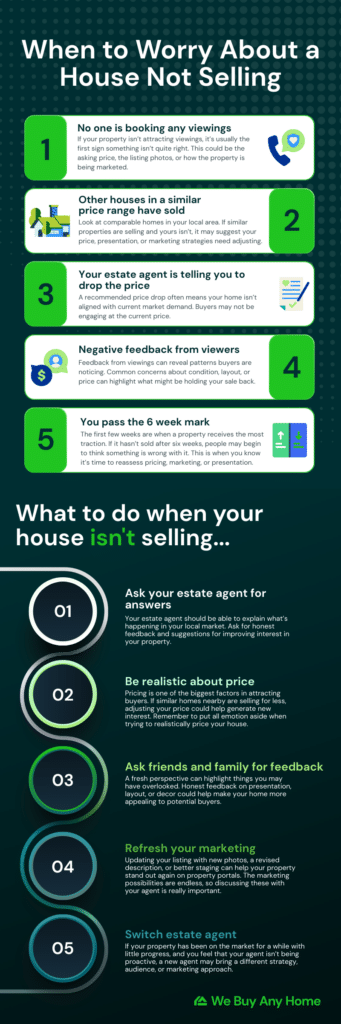
Signs that you’ve got a problem…
The level of interest your property receives is a key factor on how quickly you should worry. If you’re getting lots of viewings, but no offers, it might just be bad luck. In any event, you can gather feedback from all attendees, so you know what needs to be fixed.
The real problem is when a listing has no viewings being booked. A complete lack of interest within the first few weeks is a major red flag. In most cases, it means that your price is too high.
Don’t forget that viewers are comparing your home with all others in the same area, within the same price bracket. If similar properties appear better value, your home instantly falls down the list.
Another problem is that the longer your house remains listed, the colder the leads become. Potential buyers start to assume something is wrong with the home, even if that’s not true.
Ironically, the problem often becomes self-perpetuating. The longer a house remains unsold, the more suspicious buyers become. Perception is everything in property selling, after all.
Is it always the estate agent’s fault?
When your house is struggling to get any offers, it’s natural to want to blame your estate agent. After all, they’re the expert in this area, and have more experience than you. So, is it fair to always point the finger at them?
There’s no doubt that a poor estate agent can sabotage a property sale. Weak marketing, poor communication and unrealistic valuations combine to create a recipe for disaster.
In other cases, though, they may be a victim to your unrealistic price expectations. If they encouraged you to list the property for less than currently, and no offers are coming in, then it might be time to listen.
Marketing quality also matters enormously. Look at your listings, including the photographs, and put yourself in the shoes of a scrolling viewer. Ask friends and family for their opinion, and get stats on the online page visits, too.
It’s time to get real about pricing
There’s one key difference between the successful sellers and the unsuccessful ones: realism about price.
Overpricing remains the single most common reason properties struggle to sell. Sellers often rely on outdated comparisons or emotional attachment when setting their asking price.
The problem is that buyers do the opposite. They compare your home with dozens of other properties available right now. If your house looks expensive next to the competition, interest evaporates instantly. Especially because they’re reluctant to part with more money than needed.
One survey found that more than half of sellers in the United States eventually reduce their asking price from where it begins. The same dynamic exists in the UK market.
Price reductions can rescue a listing, but they also come with risks. Repeated cuts send signals to buyers that the seller is desperate or the property has issues. Some buyers deliberately wait for those reductions before making an offer.
The most effective strategy is accurate pricing from day one.
Steps to take when your house isn’t selling
When a property refuses to sell, the worst response is doing nothing. You need to identify the cause and then take action to rectify it.
Analyse your competition in the area, within the same price bracket. Get an outsider’s opinion on how your home stacks up in terms of price, presentation and marketing. If similar homes are selling quickly while yours isn’t, the difference usually becomes obvious.
Marketing also deserves attention. In today’s property landscape, most buyers begin their search online. You could get new photos taken, a floor plan updated, or rejig your description.
Third, you might want to speak to other estate agents who’ve successfully sold within the same price bracket recently. A dual agency arrangement could be to your benefit. Especially if your current estate agency is complacent and not working hard to do right by you.
As long as you adapt quickly and cut right to the source of the problem, you stand a fighting chance of getting things back on track.
Warning signs before you list your property
If your house is struggling to sell, then it’s possible that the issues are deeply built in. In fact, you might’ve been able to predict this situation (perhaps you did!) before it was listed on the market.
Location plays a major role. When there’s a high crime rate in your area, or you’re based on a noisy road, you’re at a disadvantage. Limited transport links and weak local schools can also reduce demand dramatically.
Kerb appeal matters too. Your garden will ideally not be neglected, and there mustn’t be a noticeably damaged exterior. Viewers will spot these in the online listing and won’t bother booking a viewing at all.
Inside the property, outdated interiors present another obstacle. Most modern-day buyers want a house they can move into straight away. Old kitchens, worn carpets and dated bathrooms show that there’s going to be extra expense, aside from the upfront cost.
Structural problems create even bigger barriers. And finally, properties with complicated histories sometimes struggle. Homes that have repeatedly appeared and disappeared from the market attract suspicion, as buyers assume previous deals collapsed for a reason.
These issues should either be sorted before you list the house on the market, or your asking price must be adjusted to match.
Stories of successful sales in difficult markets
Despite all these challenges, some sellers manage to get good deals, even in difficult situations.
One story shared by a property professional involved a home that was burgled during the selling process. Appliances were stolen and even the quartz worktop from the kitchen island disappeared.
Yet, instead of panicking, the owners took a strategic approach. They brought down the asking price by just under 10% and relaunched the listing. The result was unexpected: multiple buyers saw the adjusted price as a bargain and began competing. A bidding war followed and the house sold quickly.
Another example highlights the power of flexibility – as they received viewing requests outside of typical working hours. Since they accommodated these requests, one of those viewers ended up making a sale, and completing on the house.
Stories like these show that houses rarely sell purely because they are perfect. Instead, they sell because sellers respond intelligently to challenges.
The future of house selling: what changes are coming?
There’s no doubt that house-selling will change slightly over the next few decades. And the government is already implementing legislation to speed up this process.
Online property portals dominate the search process, and this is unlikely to change. So, this places more emphasis than ever before on digital presentation, and an understanding of Search Engine Optimisation (SEO).
Photography, video tours and even drone footage now influence buyer decisions before they step through the door. You might not get any viewings if you don’t have these elements at all, or if they’re poorly put together.
Data is also playing a growing role. Sellers now have access to detailed analytics showing how many people viewed their listing, clicked photographs or requested more information. Those insights can help you and your estate agent to adjust strategies much faster.
Looking ahead, transparency will likely increase across the property market. Buyers expect more information upfront about property history, pricing data and local conditions. That transparency will make overpricing far harder to sustain.
Never ignore the signals
Selling a house almost never follows a perfect script. Sometimes, everything aligns and offers arrive within days. Other times, the process becomes slow, frustrating and uncertain.
The key is recognising the difference between normal delays and genuine warning signs.
A property receiving regular viewings still has life in the market. But silence in the first few weeks needs to be addressed. Most importantly of all, as a seller, you must remain realistic.
The housing market is brutally honest. Buyers compare everything, analyse pricing carefully and move quickly when value appears. You therefore need to have the difficult conversations and respond when the market is sending you signals.