When you speak to anyone who’s sold their house in the UK, and ask how long it takes, they’ll probably give you the same answer:
“Much longer than you expect!”
And if you’ve been in this unfortunate position before, then you already know exactly what we’re talking about.
Everyone needs a place to live, and thousands of house transactions happen all over the UK every year. By this logic alone, you’d think that you’ll be fighting buyers back from your front door when you list it on the market.
In reality, the process is more like a slow-motion obstacle course. You need to navigate the hurdles of delays, paperwork, time wasters, and lots of stress.
So, have you ever wondered how long it really takes to sell a house in the UK? Let’s dig into the numbers, the causes, and the very human cost of a system that many now say is broken.
The headline figures (and why they don’t tell the whole story)
If you ask Google how long it takes to sell a house, you’ll usually see one neat statistic: around six months.
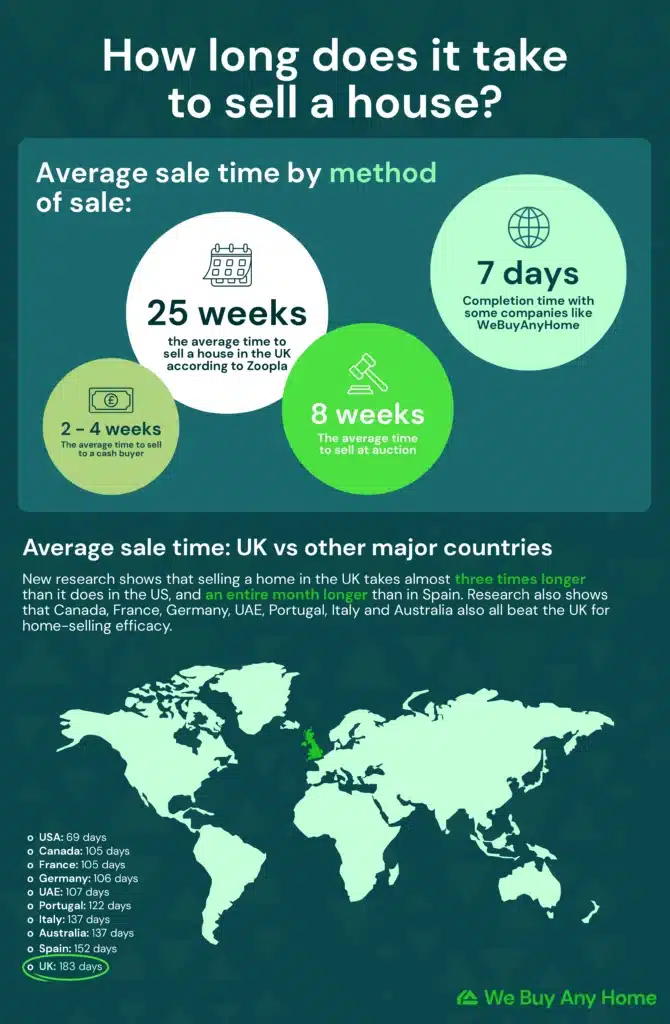
According to Zoopla, the average UK house sale takes roughly 25 weeks from first contacting an estate agent to completion day. That’s about 150 days. Already, that’s long enough to test anyone’s patience, but even that figure doesn’t tell the full story.
More recent research paints a gloomier picture. Several large-scale studies now suggest the average time to sell has drifted well beyond the 200-day mark.
One widely cited piece of research found it takes around 205 days on average, with Inner London and the South East pushing closer to 220 days. Even areas that traditionally moved faster are slowing down.
What’s particularly revealing is how that time breaks down. On average, it can take around 80 days just to find a buyer. That’s a pretty painstaking process, because you never know when the right person is going to walk through the door. Until then, you’re tidying your house on a weekly basis – only for the viewing to yield nothing of substance.
And throughout all of this, nothing is legally binding until contracts are exchanged. In other words, you can spend half a year inching towards the finish line, only for the entire thing to collapse in the final stretch. At that point, you’re right back to square one.
Even once contracts are exchanged, many sellers still wonder exactly when the money will arrive in their account. Our guide on when you can expect to receive funds from your house sale explains how the payment process works after completion.
Why the UK is so slow compared to other countries
If selling a house in Britain feels uniquely painful, that’s because it is.
It’s natural to assume that the entire world is going through the same thing, and we’re all in this together. That isn’t exactly true, though. In reality, some of the other developed nations have much better sales statistics.
In the United States, the average home sale completes in just over two months. Canada, France and Germany all manage it in around three to four months. Even countries with similarly complex property markets, like Australia and Italy, consistently beat the UK.
The UK regularly comes out as one of the slowest places in the world to sell a house. And it’s not because of the people living in the country – it’s because the process is outdated.
A quick look further north, into Scotland, will show you how easy it is for things to go differently. There, sellers pay for a Home Report before listing, giving buyers far more certainty early on. In a recent report, Scotland had an average selling time of 145 days – compared to over 200 days in many parts of the UK, according to the same study.
Likewise, in Australia and the US, contracts are often signed at the beginning of the process, not the end. These systems aren’t perfect, but they dramatically reduce fall-through rates and wasted time.
In England and Wales, the system hasn’t fundamentally changed for decades.
The hidden cost of delays and fall-throughs
When a potential house sale collapses, as it frequently does in the UK, it’s natural to assume that it creates a financial problem. In truth, though, there’s a considerable emotional toll involved, too.
Independent analysis suggests that more than half a million UK property sales fall through each year. This costs consumers hundreds of millions of pounds in lost fees. The average failed transaction costs over £1,200, and for many people, it’s far more than that.
At the same time, people lose months, sometimes years, of their lives stuck in limbo. Relationships become strained, and occasionally fall apart, due to the stress involved. Plenty of people describe being unable to sleep, which can affect job performance, or even your relationship with your kids.
For those caught in chains, the pressure is relentless. One delay ripples through multiple households. A single survey issue or mortgage hiccup can unravel everything. If you’re renting in the meantime, the costs climb even higher, putting a strain on your finances because you want to get out as soon as possible. Emotions often boil over in situations like this.
It’s no exaggeration to say that for many people, selling a house in the UK is one of the most stressful experiences of their adult lives.
Why some homes sell faster than others
Of course, not every house takes the same amount of time to sell. And for those that complete in a faster timeframe, some of the difficulty outlined above can be negated.
Location matters enormously. Certain towns and postcodes consistently outperform the national average, often because of strong local demand, good transport links or popularity with first-time buyers. Others lag behind, sometimes by months.
A recent study found that some of the slowest areas to sell a house includes Wolverhampton (164 days), The Wirral (158 days), Bristol (154 days), Warwick (152 days) and Stourbridge (152 days). Meanwhile, some of the other fastest areas to sell a house includes Southend on Sea (106 days), St Albans (108 days), Maryport (110 days) and Peterlee (111 days).
Property type plays a role, too. Flats, particularly leasehold ones, tend to take much longer to sell, partly because buyers are more cautious and paperwork is more complex. Detached houses often move faster, especially in areas where they’re in short supply, because everyone wants to live in one.
Timing is another factor. Spring is traditionally the busiest season, while the market slows noticeably during the summer holidays and grinds almost to a halt over Christmas.
Then there’s pricing, which is one of the most crucial details, yet is something you can control. Overpricing is one of the biggest causes of delay. By being realistic about your selling price, you significantly improve your chances of speeding up the selling process.
It’s strongly recommended that you thoroughly vet potential buyers, too. Not everyone who puts an offer on your house is trustworthy. Get your estate agent to take a look at their finances to double-check that they’re a credible candidate. Otherwise, you could waste your time down a rabbit hole.
If your property has been sitting on the market for months with little interest, there may be deeper issues affecting demand; our guide on why you may be struggling to sell your home breaks down the most common problems sellers encounter.
How to sell faster than average
While you can’t control the entire system, there are ways to tilt the odds in your favour. And these are often a lot simpler than you might expect.
Preparation is everything when you’re trying to sell your house quickly. Make sure to get all your paperwork sorted at the beginning. Then, choose a proactive solicitor, and be responsible at every stage of the process.
Pricing accurately, based on recent sold prices rather than optimistic estimates, attracts more serious buyers early on. This is easier said than done, though, because it forces you to take the emotion out of the sale. In other words, it doesn’t matter what you think the house is worth – it only matters what potential buyers think.
Presentation matters too. Excellent online marketing can drag lots more people to your listing, so take a look at any estate agent you consider, and decide whether their existing strategy is something that catches your eye.
Try to be flexible when accommodating viewings, as this can help attract more potential buyers. In some cases, alternative routes such as auctions or selling to a cash buyer can speed up the process and provide greater certainty. However, this usually involves a trade-off: while you may secure a faster, more guaranteed sale, it may come at the expense of achieving the highest possible price on the open market. For many sellers, the reduced stress and quicker outcome can make this a worthwhile compromise.
The uncomfortable truth about selling in Britain
For all the talk of reforms, digitisation and consultations, the uncomfortable truth is this: selling a house in the UK is still a time-consuming gamble.
In Q3 of 2025 alone, more than 82,000 sales collapsed in England and Wales according to property services data. And Optional data suggests that nearly a third of all UK property sales fell through earlier in the year – it was around 31% in the first quarter of 2024.
The fact that millions still endure it says less about the system’s quality and more about how deeply ingrained it is in British life. People accept it because they feel they have no choice.
As more sellers look for alternatives, and as pressure builds from consumers, lenders and industry bodies, change may finally be unavoidable.
Until then, if you’re planning to sell your house in the UK, the best advice is simple: assume it will take longer than you think, prepare for bumps along the way, and don’t underestimate the emotional side of the journey. Preparation and realism will put you in an excellent position. Good luck!