With so many people selling a house in the UK each year, you’d think it’d be simple to find out how much your house is worth.
Wrong. Unfortunately, this area remains a bit of a ‘black box’, and each person you speak to can have a totally different opinion from the next. So, it’s only natural to feel a bit stuck and unsure where to set your expectations.
If you ever ask homeowners about their house value, you’ll probably get confident answers. They’ll tell you that “the neighbour sold for X” or “an estate agent told us it’s worth X”. This can sound reassuring and conclusive, except for one key detail:
Your house is only worth whatever someone is willing to pay for it!
Now, it’s not totally random how a potential buyer values your house. There are lots of factors they use to inform their decision, and you can control quite a few of these. If you speak to any one party who tells you, with complete certainty, that they’ve got the magic formula for a high-quality sale… run like the wind.
So, what is your house really worth? And why on earth do valuations vary so wildly? It’s an emotional topic, so try to stay calm as we take you through the cold, hard facts.
The national picture: what UK homes are actually selling for
Let’s start with the big number everyone quotes when chatting around the dining table.
As of late 2025, the average UK house price sits at around £271,000. That figure comes from sold-price data, not estate agent wishful thinking. It reflects what buyers have actually paid, not what sellers hoped for. And there’s a big difference between those two things.
On the surface, the market looks surprisingly resilient. Annual growth is ticking along at roughly 2% to 3%. Month to month, prices wobble but broadly hold steady. This is quite reassuring for a country that’s gone through interest rate challenges, cost of living crises and non-stop changing governments.
These averages don’t always tell the full story of how it varies by region, property type, or even stress.
Northern Ireland has experienced the fastest growth, with roughly 94% of houses rising in value, with an average gain of £14,200. Scotland ranks second, with 73% of properties rising by an average of £10,400.
The North West also performed strongly, with 72% of properties gaining value and average rises of £9,700.
Meanwhile, 6 in 10 properties that lost value over the past year were in southern England. And flats in these southern regions were undoubtedly the property type that took the biggest hit.
So, although it’s natural to assume that the southern property market is always flourishing, it’s actually taken a backstep in recent times. Despite this, house values in Scotland and Northern Ireland have continued to grow.
Perception and reality are drifting apart
One of the biggest problems in the UK housing market is that most people anchor their expectations to the wrong numbers.
They look at asking prices, not sold prices. There’s a huge difference between these two things. And it’s common to compare yourself to the best house on the street, not the one most similar to yours.
Another barrier is the inevitable emotion that comes with selling your house. When you attach emotion to bricks and mortar, it makes it tricky to see clearly. When you look at your home, you see the place that your children grew up, and where lots of happy memories reside. A potential buyer can’t see these things, which can create a rift between expectation and reality.
To put it bluntly: mortgage surveyors work from evidence, not vibes. This tends to create some uncomfortable conversations. They look at recent comparable sales, condition, demand and risk. In a slower, more cautious market, they err on the side of restraint. That’s why down valuations are becoming more common.
Third‑party reports note that many valuations come in around 2% to 5% below agreed sale prices. In some extreme cases, it’s even larger, especially in high‑value markets like London and the South-east.
The result is a growing mismatch between what sellers believe their home is worth and what the market is prepared to support. By sticking to the facts, and leaving your emotions at the door, you’re less likely to fall into this trap.
How do modern-day house valuations compare to the past?
British house valuations have had quite the rollercoaster ride over the years. And believe it or not, the story starts all the way back in 1086, when the Domesday survey effectively valued all the land in England at around £70,000.
Fast forward to today and the average UK home hovers around £270,000, with prices broadly doubling decade by decade. It hasn’t been a straight trajectory to get to this point, though. In fact, between 1845 and 1910, prices actually drifted steadily downward.
Back in 1845, a typical home cost about 13 times the average salary, yet this was also the era when a building boom flooded the market. Housing supply more than doubled in just 70 years, rising from 3.8 million homes in 1851 to 8.9 million by 1911.
Property itself changed too, shrinking from grand detached homes averaging 913 square metres, to tighter terraced homes around 258 square metres.
The early 1900s then flipped Britain from a renter nation (about 75% renting in 1918) to a homeowner nation.
A tale of two markets: north vs south, houses vs flats
Another reason the national conversation is so confusing is that there isn’t really one UK housing market anymore. There are lots of different local markets, each with totally different price points, and which grow or decline are different rates.
In much of northern England, Scotland and Northern Ireland, prices have been rising steadily. Demand remains strong, affordability is relatively better, and buyers still see value. Meanwhile, prices have temporarily softened in southern England.
This regional and structural split explains why two people can talk about house prices and feel like they’re living in different countries. It makes perfect sense – because they’re looking at completely different parts of the market.
The common traps of an estate agent valuation
You’re not alone if you think that the estate agent valuation is the ‘be all and end all’ of your house price. And while it’s crucial that you take them seriously, and understand their reasoning behind a certain number, it’s slightly more complicated than that.
Estate agents are looking to win your business, which means that they often tell you ‘what you want to hear’. This can create some unreliable feedback, because they inflate your house valuation, without giving it to you straight.
Before agreeing to work with an agent, it’s also important to understand the terms you’re signing up to, as explained in our estate agent contracts guide.
The best agents explain their reasoning. They show you comparable sold prices, not just listings, and they outline the current buyer demand in the area. And crucially, they have a plan for how to get offers, not just views.
You should also get multiple valuations, as this can make your journey towards landing on an accurate valuation much easier. Blindly choosing the first one you hear is sales suicide. Instead, get some independent expert opinion, and make sure that your asking price is backed by evidence.
Some situations require a more formal valuation too, particularly when dealing with inherited property or legal matters. If you’re managing an estate after someone has passed away, our guide to house valuation for probate explains how the process works and why accurate figures matter.
The four opinions that decide your house price
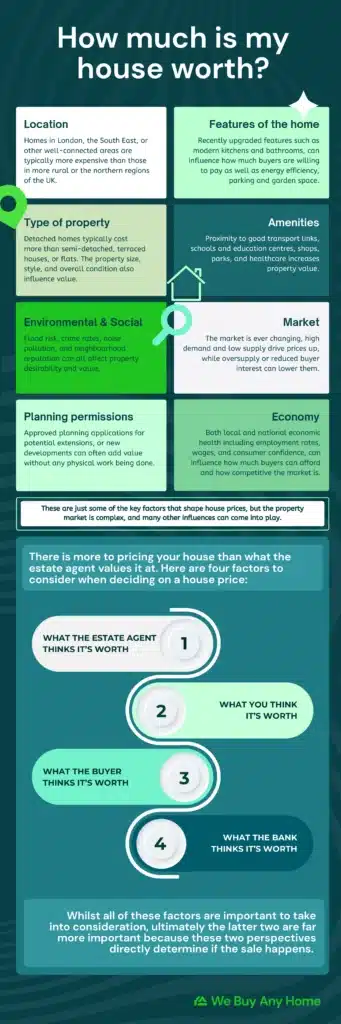
Every property sale quietly passes through four separate judgements, each with the power to change the outcome. Some of these opinions are far more influential than others, though.
First is the estate agent’s view, which shapes the asking price. As long as you choose your estate agent carefully, you should take guidance from this professional, because they’ve got a broader perspective on the entire market.
Second is your expectations, which determines whether you accept offers. Sometimes, there might not be consistency between what you hope to sell for, and what’s realistically possible. This can create some friction.
Third is the buyer’s perception, which drives what they’re willing to pay. It will be informed by other properties on the market, the quality of your marketing, and how desirable your area is.
And finally, there’s the lender’s valuation, which often has the final say. They won’t lend you more money than they believe the house to be worth – which can sometimes create a sticking point, and bring the sale to a halt.
When all four broadly align, sales progress smoothly. When they don’t, problems begin. And the latter scenario is far more common.
In recent years, lenders have become noticeably more cautious. Valuations coming in 2% to 5% below agreed prices are no longer unusual, particularly in slower markets. Buyers then face a choice: find more cash, renegotiate, or walk away.
What influences the value of your house?
You’ve already seen that the value of your house is determined by a blend of hard data and human perception. Some key features make a much bigger difference than others, though.
Location is still the single biggest driver of price. Proximity to good schools, reliable transport links and low crime rates can add significant premiums. Meanwhile, if you live on a busy main road, or are in a flood risk zone, your value will take a hit. Even within the same town, prices can vary quite a lot from street to street.
Property size and layout are two of the other most crucial details. Square footage, number of bedrooms and bathrooms, and flexible living space all influence the buyer demand for your house.
Condition is another major factor: modern kitchens, updated bathrooms and efficient heating systems often translate into higher valuations.
Energy performance is rising in importance as bills and regulation tighten. Homes with strong EPC ratings are favoured. Especially because anything below a ‘C’ will be impossible to let out in the coming years.
Market conditions overlay all of this. Interest rates and mortgage availability will either push up prices, or drag them down. This is more likely to occur on a regional level, rather than street by street.
Price your house correctly… or else!
In a slower market, pricing mistakes are punished quickly. You need to be honest with yourself, or you’re setting yourself up for failure.
A home priced correctly from day one is significantly more likely to sell. Those that aren’t often linger, accumulating days on market and doubts in the mind of anyone who comes to view it.
The first two weeks of a listing are critical. Miss that window with an unrealistic price, and it’s very hard to recover momentum. In this sense, your marketing can have as big an impact on house value as anything else.
The irony is that overpricing often leads to a lower final sale price than a realistic launch would have achieved. Buyers sense desperation, which causes them to be tougher in negotiations.
So… how much is your house really worth?
The honest answer to this question is uncomfortable – so, buckle in.
Your house is worth what someone is willing and able to pay, and what a lender is willing to support, at a specific moment in time.
Your house value can change from month to month – both upwards, and downwards. And each potential buyer can view it differently, and be looking to buy it for different reasons.
Your neighbour’s selling price, or what your gut feelings are telling you, are not reliable barometers. Likewise, online tools, or an estate agent who’s trying to win your business, should also be treated with scepticism.
Understanding that gap between perception and reality is the difference between a smooth sale and months of frustration.
When it comes to selling your home, the right price isn’t the one that feels best. It’s the one that actually gets you moving. So, bite the bullet and get realistic – you’ll thank yourself for it in the long run.