If you’ve browsed property listings on Rightmove or Zoopla recently, then you’ve probably come across the same phrase a few times: ‘guide price’.
You’re far from alone if you don’t know what this means. It seems that each person describes their expected selling price in a totally different way. And it’s left to you to read between the lines.
Each person who lists a ‘guide price’ when selling a house may do so for a different reason. If you’ve done the same, then perhaps an estate agent encouraged you, or you were simply feeling unsure about the market’s demands.
There’s quite a lot riding on such simple wording. Pricing is undoubtedly the most important decision in any property sale. If you set the wrong figure, your house can sit unsold for months. Price it correctly and the same property attracts multiple buyers in a matter of days. Who knows – maybe a bidding war will commence.
The best estate agents understand this and know how to use it to their advantage. You’ll be guided on how to price it, with what wording, and why that’s the best approach.
So, is it really a subtle science? Or is there more guesswork than most agents would have you believe? Let’s take a look.
Mind games are the bedrock of the UK property market
Selling a house involves far more psychology than you might initially realise.
Pricing strategies influence how buyers behave, how many people view your property, and how much it ultimately sells for. In fact, the price itself often acts as a marketing tool.
Across the world, companies have long relied on psychological pricing. Supermarkets famously price products at £1.99 rather than £2 because consumers instinctively round down and perceive the item as cheaper. Research has shown that these small differences genuinely affect purchasing behaviour.
Property sellers adopt similar tactics – which is hardly surprising, when you consider how much money is on the line.
For example, listing a home at £249,000 rather than £250,000 could possibly create the impression of a better deal. Buyers browsing search filters also notice it, because it shows up in a lower price band on Rightmove. Some estate agents argue that this approach is ‘cheap’ and untrustworthy – others disagree.
These details matter enormously in a competitive housing market.
Pricing strategies thus aim to achieve two goals: attract as many viewers as possible and create a sense of urgency among them. When a property receives heavy interest, buyers become nervous about missing out. That emotional pressure can push offers higher.
This is where the concept of a guide price enters the conversation.
What exactly is a guide price?
In the simplest terms, a guide price is an indication of what the seller expects for a property.
Unlike a fixed asking price, you can use a guide price to show that you’re flexible to negotiations. If you use a guide price range (for example, £500,000 to £525,000) then it can really make things interesting.
Importantly, a guide price is not binding, as it doesn’t represent the exact amount you aim to accept. Instead, it starts a conversation.
In many cases, buyers assume the guide price reflects the likely sale price. That assumption regularly proves incorrect. In fact, homeowners often move their guide price throughout the selling price, if they get more (or less) interest than expected.
All of this can prove challenging, though, when there’s a gap between expectations and reality.
Recent statistics show there was a 17.1% gap between the average UK asking price and the final selling price, equivalent to £62,602 at the time. That figure illustrates how fluid property pricing really is.
Don’t forget that the term ‘guide price’ is also used in property auctions, although this means something different. In that context, it indicates where bidding will begin, and is usually set within 10% of the confidential reserve price (although not always).
This distinction can create confusion for many first-time buyers, which is only natural. The principle remains the same, though: a guide price acts as a signal of the seller’s mindset.
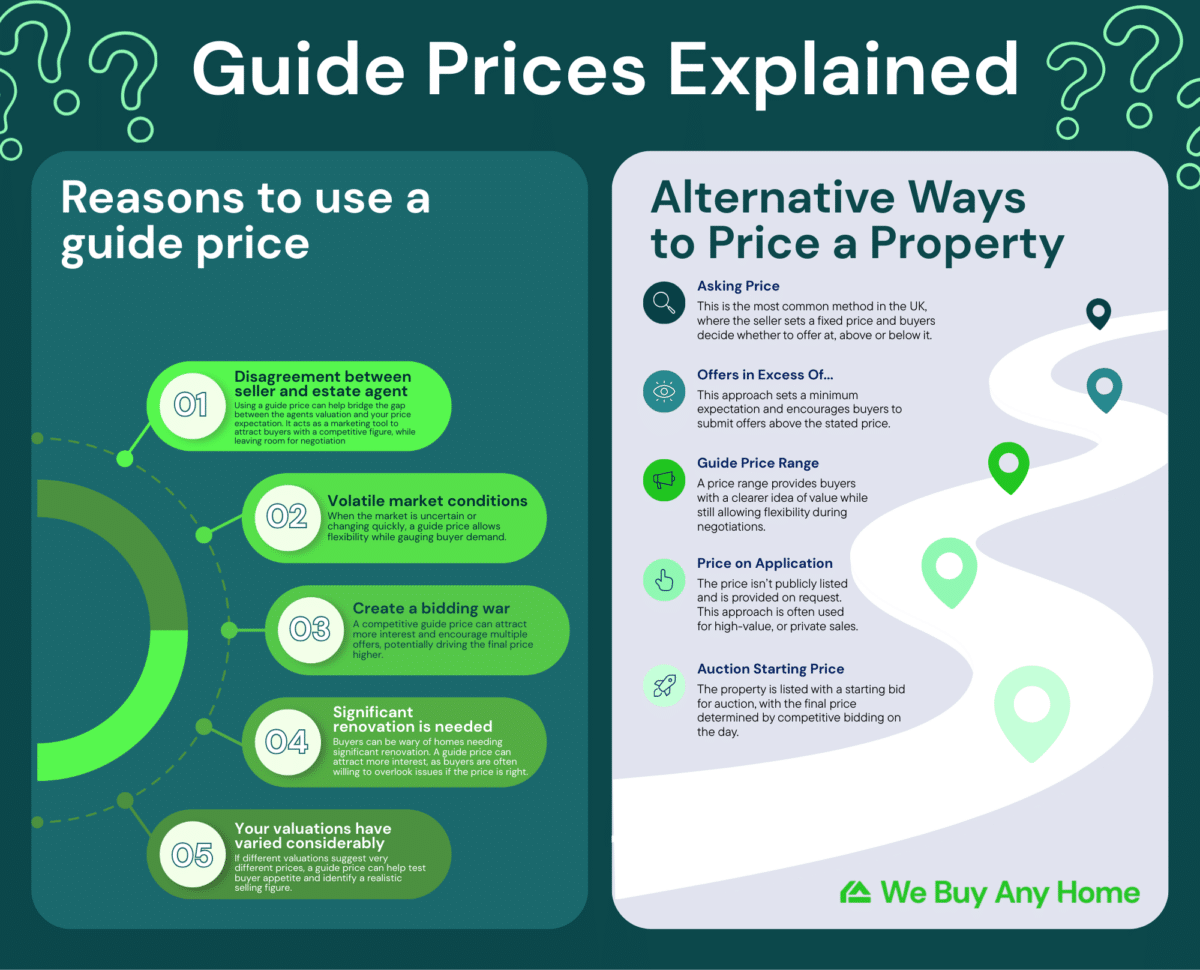
Reasons to use a guide price
You could use a guide price to sell your house for a variety of reasons.
One of the most common is quite simple: uncertainty about what to list it for. This is especially challenging when the economy is in a period of instability. When interest rates fluctuate, or governments introduce new laws, it’s difficult to know how the market will react. Pinning down a precise asking price thus becomes difficult.
A guide price could also become a smart option when you and your estate agent disagree. If you think it should be listed at a certain price, but they’re quite far away from seeing eye-to-eye on that, then you could use a guide price range that incorporates both perspectives.
A guide price also offers you flexibility and filters out unrealistic buyers. By signalling the general price range, you won’t waste time on viewers who can’t afford the property.
Some estate agents deliberately set guide prices below the property’s expected value to generate interest. Lower numbers attract more online searches, more viewings, and ultimately more competition. This will hopefully begin a bidding war.
Sometimes, the condition of the property plays a role, as well. When your home needs quite a lot of tender love and care, its value depends heavily on a buyer’s plans for improvement. A guide price covers all your bases.
Tips for offering on a ‘guide price’ house
So, let’s say you’re a buyer looking to offer on a house with a ‘guide price’ listed. Where do you begin?
Most experienced buyers treat the guide price as the starting point of negotiations, rather than a fixed target. In many cases, you’ll find buyers offering around 5% below the guide price, depending on market conditions and the property’s appeal.
Don’t forget that context matters enormously. You can always speak to the seller’s estate agent for a sneak peek into the mind of the owner.
If the property has just appeared on the market and demand is strong, a low offer rarely gets serious consideration. If the house is listed for a while, though, then you have more negotiating power.
The buyer’s position also plays a huge role. The seller will respond to you much better when you’re chain free or able to pay with cash. In this position, you’re seen to offer speed and certainty, which every seller values.
Another useful tactic involves researching the property’s history. How long has it been on the market? Have similar homes nearby sold for less? Both will strengthen your position when explaining the offer to the estate agent.
Online valuation tools occasionally offer clues, although these estimates are notoriously unreliable. In one example shared by buyers online, a valuation platform estimated a property at £40,000 less than the listed guide price, which heavily influenced the offer strategy.
Ultimately, negotiating around a guide price remains part science, part instinct. You need to balance realism with ambition, and make sure your initial offer doesn’t insult the seller, and thus stop the negotiations before they begin.
Instances when a guide price works well
In the right situation, setting a guide price when selling a house can work well.
In competitive markets, where multiple buyers are searching, you may find each person trying to outbid the other. Buyers will view your listing, attend viewings, and start imagining how much they are willing to stretch their budget. That emotional engagement often drives the final sale price higher.
Guide prices also suit unusual properties. Homes with unique features, large renovation potential or uncertain valuations benefit from flexible pricing structures.
Another advantage lies in visibility. A slightly lower guide price ensures the property appears in more search results online. You’ll sometimes find buyers will smaller budgets stretch their finances once they fall in love with a house.
Instances when a guide price can backfire
Of course, guide prices don’t always give you the outcome you’d hoped for.
In weaker markets, they sometimes create confusion rather than excitement. Buyers sometimes wrongly assume the guide price reflects the expected sale price. This can create discord when you turn down their initial offer.
This problem appears especially often in auctions. Research shows that around 70% of people browsing auction catalogues assume the guide price represents the likely sale price.
Even outside auctions, unclear pricing signals discourage buyers. Some people stay away, simple because they can’t be bothered with the hassle. Likewise, some interpret guide prices as evidence that the property has underlying problems.
Alternative ways to price your property
Setting a ‘guide price’ is only one method of pricing your house. There are plenty of other ways to do it, and your estate agent can advise on these accordingly.
‘Asking price’ is the most straightforward. You advertise for a specific number, and wait for offers close to that figure.
‘Offers in excess of’, often abbreviated to OIEO, shows the absolute minimum you want to sell for. Buyers hopefully understand that lower bids won’t succeed.
‘Offers over’ works in a similar way to the above and is commonly used in parts of Scotland.
‘Price on application’ means that you’ll be told the asking price when you contact the estate agent directly. Until then, it remains a mystery.
Each strategy reflects the seller’s priorities. A skilled buyer will read between the lines, and speak to the estate agent, to find out what the selling strategy means.
Will guide prices become more popular?
If you’re looking for a sign that guide prices are going away, then we’ve got bad news. There’s no indication of this happening yet.
Yet the way they are used will continue evolving. As the housing market becomes increasingly data-driven via online portals, valuation tools and digital analytics, buyers have far more information than they had a decade ago. When transparency increases in this way, vague pricing signals lose some of their power.
There is also growing debate within the auction sector about getting rid of the term altogether. Some industry figures argue that replacing ‘guide price’ with clearer phrases such as ‘minimum selling price’ would stop buyers from getting confused.
At the same time, alternative selling routes are gaining traction. Cash buying companies, online agents and hybrid platforms offer faster transactions and simpler pricing structures. These models favour clarity over subtle negotiation tactics.
Even so, human psychology remains a powerful force in property markets. As long as those emotions exist, pricing strategies will continue to play a role.